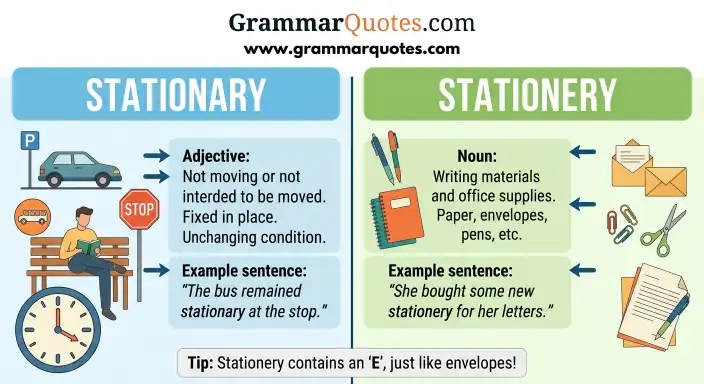
Stationary and stationery are both correct spellings, but they have different meanings. Stationary is an adjective that means staying in one place or not moving. Stationery is a noun that refers to writing materials, such as paper, envelopes, pens, and notebooks.
For example, “The car remained stationary at the traffic light” uses the first word correctly, while “I bought new stationery for school” uses the second. These words are often confused because they sound almost identical, but they are not interchangeable.
The easiest way to remember the difference is to connect stationary with staying still and stationery with writing supplies. Once you understand this simple distinction, you can use both words correctly in schoolwork, emails, business writing, and everyday conversations.
Quick Answer: Stationary or Stationery?
- Stationary: An adjective meaning still, fixed, or not moving.
- Stationery: A noun meaning writing materials and office supplies.
- Stationary example: The bicycle remained stationary outside the shop.
- Stationery example: She bought notebooks and stationery for school.
- Memory trick: Stationary means staying still. Stationery means writing equipment.
Both spellings are correct. The right choice depends on what you want to say.
What Is the Difference Between Stationary and Stationery?
The main difference is their meaning and grammatical use.
| Feature | Stationary | Stationery |
| Part of speech | Adjective | Noun |
| Meaning | Not moving or staying in one place | Writing materials and supplies |
| Common context | Vehicles, objects, positions | Schools, offices, letters |
| Example | The train remained stationary. | I purchased new stationery. |
| Memory clue | Staying still | Envelopes and writing supplies |
When to Use Stationary
Use stationary when describing a person, object, or vehicle that is not moving.
Examples:
- The bus remained stationary for several minutes.
- The athlete stood stationary near the starting line.
- The camera was stationary during the recording.
- The moon appears to move across the sky, while distant stars can seem stationary over short periods.
When to Use Stationery
Use stationery when referring to materials used for writing, printing, or office work.
Examples:
- I bought stationery for my new school year.
- The office ordered paper and other stationery supplies.
- She wrote the invitation on beautiful stationery.
- The shop sells notebooks, envelopes, and stationery sets.
Definition and Meaning of Stationary
Stationary means not moving, remaining in one position, or staying in the same place.
It is an adjective, so it describes a noun. You can use it for vehicles, objects, people, equipment, or other things that remain still.
Examples of Stationary in Sentences
- The car stayed stationary while the traffic light was red.
- The guard remained stationary beside the entrance.
- The machine must remain stationary during the test.
- The helicopter hovered almost stationary in the air.
- The vehicle was stationary when the accident occurred.
In these examples, stationary describes something that is not moving or changing position.
Synonyms for Stationary
Some common synonyms for stationary include:
- Still: Not moving.
- Motionless: Completely without movement.
- Immobile: Unable or not expected to move.
- Fixed: Firmly placed or set in position.
- Static: Not moving or changing.
- Unmoving: Not moving from a position.
Example: “The car remained motionless” has a similar meaning to “The car remained stationary.”
However, these synonyms are not interchangeable in every context. For example, fixed can also mean firmly attached or decided.
Definition and Meaning of Stationery
Stationery refers to writing materials and related supplies, including paper, envelopes, notebooks, letterheads, and similar items.
It is a noun. People commonly use it when discussing school supplies, office materials, invitations, letters, and business documents.
Examples of Stationery in Sentences
- I need to buy stationery before classes begin.
- The company ordered stationery with its logo.
- She keeps her stationery in a desk drawer.
- The invitation was printed on elegant stationery.
- The shop sells stationery, greeting cards, and notebooks.
In these examples, stationery refers to items used for writing, printing, or communication.
Examples of Stationery Items
Common stationery items include:
- Notebooks and writing pads
- Paper and envelopes
- Pens and pencils
- Letterheads and business cards
- Sticky notes and folders
- Greeting cards and invitations
- Labels and writing paper
Remember that stationery describes a category of supplies rather than one specific item.
Origin of Stationary and Stationery
The words stationary and stationery are related historically to the word station, which comes through Old French from Latin statio, meaning a standing, position, or place where someone or something stands.
Stationary developed the meaning of remaining in one position or not moving.
Stationery became associated with writing materials through the historical use of stationer for a bookseller or seller of writing supplies. Over time, stationery came to mean the materials sold by such merchants.
Although the two words share a historical connection, their modern meanings are different. Their similar pronunciation makes them a common source of spelling confusion.
Pronunciation of Stationary and Stationery
In most English accents, stationary and stationery are pronounced identically or very similarly.
- Stationary — US: /ˈsteɪ.ʃə.ner.i/
- Stationary — UK: /ˈsteɪ.ʃən.ri/
- Stationery — US: /ˈsteɪ.ʃə.ner.i/
- Stationery — UK: /ˈsteɪ.ʃən.ri/
Pronunciation can vary slightly by accent, but the words are generally homophones, meaning they sound alike while having different meanings and spellings.
Because pronunciation usually cannot help you distinguish them, it is important to remember their definitions.
Stationery vs Stationary: Common Grammar Patterns
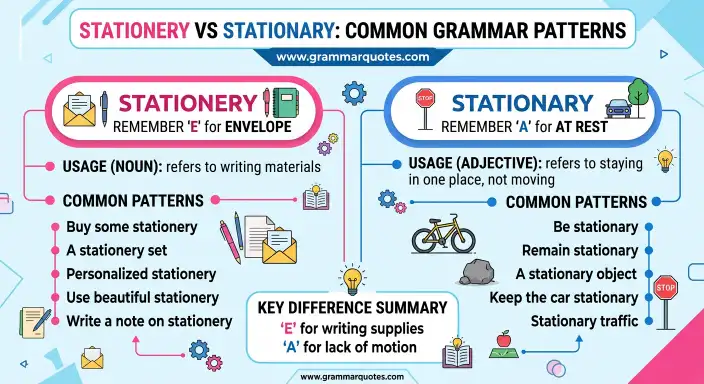
Understanding how each word functions in a sentence makes the difference easier to recognize.
How Stationary Works in a Sentence
Stationary is an adjective. It describes something that is still or remains in one place.
Common patterns include:
- Remain stationary
- Stay stationary
- A stationary vehicle
- A stationary object
- A stationary camera
Examples:
- The vehicle remained stationary throughout the inspection.
- We used a stationary camera to record the experiment.
- The machine must stay stationary while operating.
How Stationery Works in a Sentence
Stationery is a noun. It refers to writing and office materials.
Common patterns include:
- Buy stationery
- Office stationery
- School stationery
- Personalized stationery
- Stationery supplies
Examples:
- I bought school stationery for my younger brother.
- The office ordered personalized stationery.
- We keep extra stationery in the cupboard.
Grammar tip: If the word describes something that is not moving, use stationary. If it names writing supplies, use stationery.
Common Mistakes With Stationary and Stationery
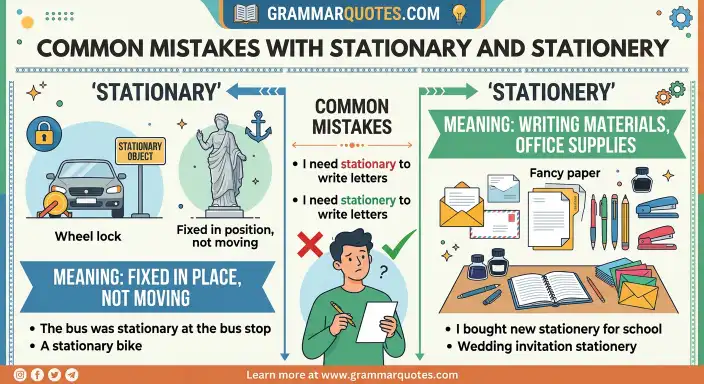
These words are easy to confuse, especially when writing quickly. Here are some common mistakes and their corrections.
Mistake 1: Using Stationery to Describe Something That Is Not Moving
Incorrect: The car remained stationery at the crossing.
Correct: The car remained stationary at the crossing.
Why? The sentence describes the car’s movement, so the adjective stationary is required.
Mistake 2: Using Stationary for Writing Supplies
Incorrect: I bought new stationary for school.
Correct: I bought new stationery for school.
Why? The sentence refers to school supplies, so the noun stationery is correct.
Mistake 3: Assuming Both Words Have the Same Meaning
Incorrect assumption: Stationary and stationery are interchangeable.
Correct explanation: They have different meanings, even though they sound alike.
Mistake 4: Relying Only on Pronunciation
Because both words are pronounced almost identically, listening carefully may not help you choose the right spelling.
Instead, identify the meaning you want to express before writing the word.
Stationary or Stationery: Everyday Examples
The following examples show how to use both words correctly in daily situations.
| Stationary | Stationery |
| The car remained stationary. | I bought new stationery. |
| The bus was stationary for ten minutes. | The office needs more stationery. |
| The camera stayed stationary. | She ordered personalized stationery. |
| The bicycle remained stationary outside. | My school stationery is in my bag. |
| The machine must remain stationary. | The store sells paper and stationery. |
| The object appeared stationary. | He gave me a stationery set. |
| The truck was stationary near the gate. | We need stationery for the meeting. |
| The athlete stood stationary. | She keeps her stationery organized. |
| The vehicle became stationary. | The company printed its logo on stationery. |
| The equipment remained stationary. | I bought stationery for writing letters. |
These examples highlight the central distinction: stationary describes a state of being still, while stationery names writing materials.
Memory Tricks to Remember Stationary or Stationery
A simple memory trick can help you avoid confusing these words.
1. Stationary Means Staying Still
Think of the letter A in stationary as the A in “at rest.”
- Stationary = not moving.
- Example: The car was stationary.
This is a memory aid, not the word’s actual origin.
2. Stationery Is for Writing
Think of the letter E in stationery as the E in “envelope.”
- Stationery = writing supplies.
- Example: I bought stationery and envelopes.
3. Ask Yourself One Simple Question
Before choosing a spelling, ask:
Am I describing something that is not moving, or am I talking about writing supplies?
- If it is not moving, choose stationary.
- If it is writing material, choose stationery.
With a little practice, this distinction becomes easy to remember.
Stationary or Stationery in British and American English
Unlike words such as colour and color, stationary and stationery are not regional spelling alternatives. Both words are used in British and American English, and each keeps its own meaning.
| Word | British English | American English |
| Stationary | Not moving | Not moving |
| Stationery | Writing materials | Writing materials |
Examples in both varieties:
- British English: The car remained stationary.
- American English: The car remained stationary.
- British English: I bought new stationery.
- American English: I bought new stationery.
The spellings do not change between these two varieties of English. The important difference is the meaning of each word.
Frequently Asked Questions
1. Is stationary or stationery correct?
Both are correct words, but they have different meanings. Stationary means not moving, while stationery means writing materials.
2. What is the easiest way to remember stationary and stationery?
Remember that stationary has an a, like “at rest,” while stationery has an e, like “envelope.”
3. Is stationery a noun or an adjective?
Stationery is a noun. It refers to writing materials such as paper, envelopes, notebooks, and related supplies.
4. Is stationary an adjective or a noun?
Stationary is primarily an adjective. It describes something that is not moving or remains in one position.
5. Are stationary and stationery pronounced the same?
In most English accents, yes. They are generally homophones, which is why writers often confuse them.
People Also Ask
1. How do you spell stationery for school supplies?
Spell it stationery when referring to notebooks, pens, paper, and other writing supplies.
2. What does stationary mean in simple English?
Stationary means staying in one place without moving.
3. What is an example of stationary in a sentence?
“The bus remained stationary at the traffic light” is a correct example.
4. What is an example of stationery in a sentence?
“I bought new stationery for my school assignments” is a correct example.
5. Why are stationary and stationery confused so often?
They are confused because they have very similar pronunciations but different spellings, meanings, and grammatical uses.
Conclusion
The difference between stationary and stationery is simple once you understand what each word means. Stationary is an adjective used to describe something that is not moving or remains in one position. Stationery is a noun that refers to writing materials such as notebooks, pens, envelopes, and paper.
Although the words sound almost identical, they cannot replace each other in a sentence. To remember the difference, connect the a in stationary with “at rest” and the e in stationery with “envelope.” Both words are spelled the same way in British and American English, so regional spelling differences are not a factor.
By learning their meanings and practicing the examples in this guide, you can avoid this common spelling mistake and use both words confidently in everyday and professional writing.
Discover More Articles!
Pajamas or Pyjamas: Which Spelling Is Correct?(2026)
Wegovy or Mounjaro: Which Is Better?(2026)
Advisers vs Advisors: Meaning, Difference, and Correct Spelling

Ethan Parker is an English-language writer known for his interest in words, language, and clear communication. His work focuses on making everyday English easier to understand through simple explanations and practical examples.