Have you ever wondered if to write principal or principle? These words sound exactly alike, but they have different meanings. Using the wrong word can change the meaning of your sentence.
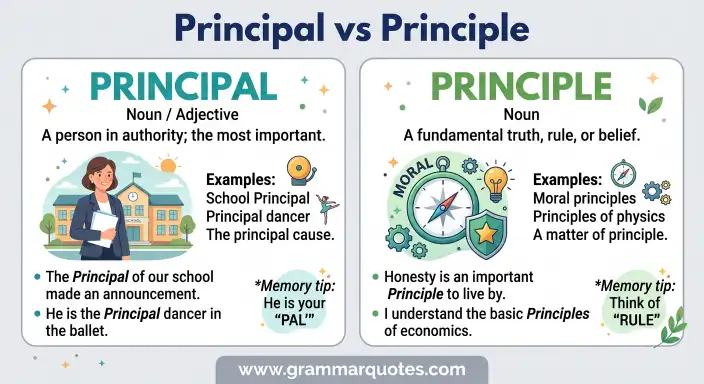
Principal usually refers to the head of a school, a person in an important position, or the main part of something. Principle refers to a basic rule, belief, value, or idea that guides decisions and behavior.
For example, a school principal manages a school, while a good principle helps someone decide what is right or wrong.
In this guide, you will learn the meanings of principal and principle, their differences, pronunciation, common mistakes, and examples. You will also discover easy ways to remember which spelling to use in everyday English.
Quick Answer: Principal vs Principle
Principal is a noun or adjective. It can mean a school leader, the main person or thing, or the original amount of money in a loan or investment.
Principle is a noun. It means a basic rule, belief, or fundamental truth.
Examples:
- The principal welcomed the new students.
- Honesty is an important principle.
- The principal reason for the delay was bad weather.
- She always follows her principles.
Easy memory tip: The principal is your pal at school. A principle is a rule or belief you follow.
What Does Principal Mean?
Definition of Principal
Principal can be used as both a noun and an adjective.
As a noun, it commonly refers to the person in charge of a school. It can also refer to the main person involved in something or the original amount of money borrowed or invested.
As an adjective, it means main, most important, or primary.
Examples of Principal in Sentences
- The school principal announced the examination schedule.
- Our principal gave a speech at the assembly.
- The principal reason for his absence was illness.
- Education is one of the principal goals of the organization.
- She paid back the loan’s principal over several years.
Common Uses of Principal
- School principal: The person who manages a school.
- Principal reason: The main reason for something.
- Principal character: The main character in a story.
- Principal amount: The original amount of money borrowed or invested, excluding interest.
- Principal investigator: The lead researcher responsible for a study.
Connotative Meaning of Principal
The word principal often suggests leadership, importance, or a central role.
For example, a school principal has responsibility for managing a school. The phrase principal concern refers to the most important concern.
The exact meaning depends on the context, but the idea of being in charge or being most important is common.
What Does Principle Mean?
Definition of Principle
Principle is a noun that means a basic rule, belief, value, or fundamental truth that guides how people think and act.
Principles can relate to morality, science, education, business, or everyday life.
Examples of Principle in Sentences
- Honesty is an important principle in our family.
- She refused to lie because it went against her principles.
- The scientist explained the basic principle behind the experiment.
- Fairness is a key principle of good leadership.
- He believes in the principle of treating everyone equally.
Common Uses of Principle
- Moral principle: A rule about right and wrong.
- Basic principle: A fundamental rule or idea.
- Scientific principle: A general rule that explains how something works.
- Guiding principle: A belief that helps guide decisions.
- Principle of fairness: The idea that people should be treated fairly.
Connotative Meaning of Principle
The word principle often suggests integrity, fairness, consistency, and belief.
For example, “She stood by her principles” means she remained loyal to her values, even when doing so was difficult.
A principle can also be a scientific or technical rule, so it does not always refer to morality.
Principal vs Principle: Key Differences
The main difference is that principal refers to a leader, something main, or a financial amount, while principle refers to a rule, belief, or fundamental idea.
| Feature | Principal | Principle |
| Part of speech | Noun and adjective | Noun |
| Main meaning | School leader, main, or original financial amount | Rule, belief, or fundamental idea |
| School example | The principal spoke to the class. | Respect is an important principle. |
| Business example | The principal amount was repaid. | The company follows ethical principles. |
| Memory tip | Principal is your pal | Principle is a rule you believe in |
Principal vs Principle: Pronunciation
Both words are pronounced the same way in standard English. They are homophones, which means they sound alike but have different meanings and spellings.
- Principal — American IPA: /ˈprɪn.sə.pəl/
- Principal — British IPA: /ˈprɪn.sə.pəl/
- Principle — American IPA: /ˈprɪn.sə.pəl/
- Principle — British IPA: /ˈprɪn.sɪ.pəl/ or /ˈprɪn.sə.pəl/, depending on accent and transcription
Both words generally have three syllables.
Because their pronunciation is so similar, you should choose the spelling based on the meaning of your sentence.
How to Remember Principal vs Principle
Remember Principal Is Your Pal
The word principal contains the word pal at the end of its spelling.
Think of a school principal as someone you may meet at school.
Example: The principal congratulated the students.
Remember Principle Means a Rule
The word principle ends with ple. Connect it with the idea of a rule or belief that people follow.
Example: Honesty is a principle that guides my decisions.
Use the Sentence Meaning
Ask yourself what you want to describe:
- A school leader? Use principal.
- The main reason or most important thing? Use principal.
- A rule, belief, or value? Use principle.
- The original amount of a loan? Use principal.
Common Mistakes With Principal and Principle
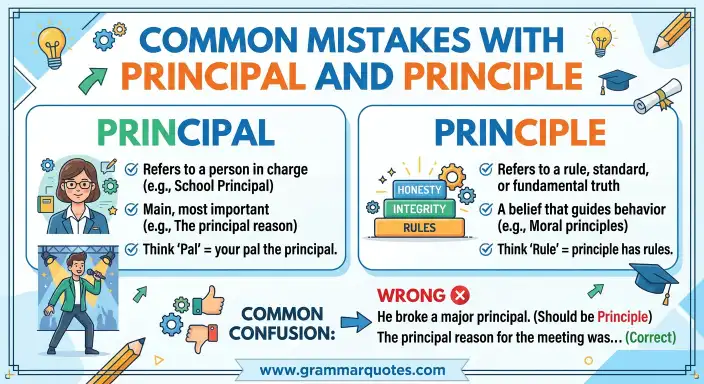
Mistake 1: Using Principle for a School Leader
Incorrect: The school principle welcomed the guests.
Correct: The school principal welcomed the guests.
Why? The person managing the school is called the principal.
Mistake 2: Using Principal for a Moral Rule
Incorrect: Honesty is an important principal.
Correct: Honesty is an important principle.
Why? Honesty is a value or guiding belief, not a school leader.
Mistake 3: Confusing Principal Reason With Principle Reason
Incorrect: The principle reason for the change was cost.
Correct: The principal reason for the change was cost.
Why? Here, principal means the main or most important reason.
Mistake 4: Confusing Principal With Principle in Finance
Incorrect: The borrower repaid the principle of the loan.
Correct: The borrower repaid the principal of the loan.
Why? In finance, principal refers to the original amount borrowed or invested.
Everyday Examples of Principle vs Principal
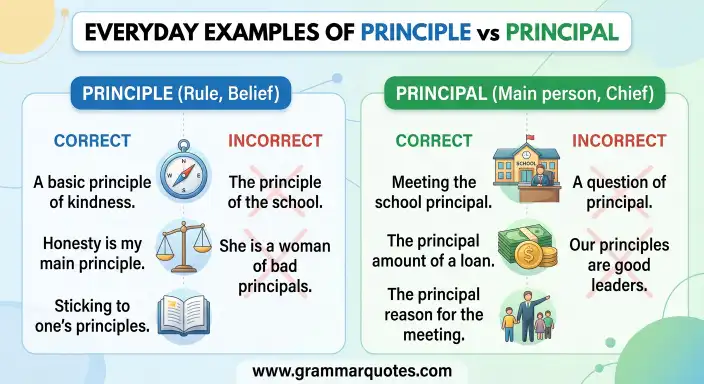
Examples Using Principal
- The principal visited our classroom.
- My school principal encouraged us to study hard.
- The principal objective of the meeting was to solve the problem.
- The company reduced its outstanding loan principal.
- The principal character in the novel faces many challenges.
- Her principal responsibility is managing the team.
Examples Using Principle
- Respect is a basic principle of friendship.
- The teacher explained the principle of gravity.
- He follows the principle of honesty.
- The organization works according to clear principles.
- She would not break her principles to gain money.
- The experiment demonstrates a scientific principle.
Synonyms of Principal and Principle
The best synonym depends on the context. These words are related in meaning but are not interchangeable in every sentence.
Synonyms of Principal
- Main: The most important.
- Primary: First or most important.
- Chief: Leading or highest in importance.
- Head: The person in charge.
- Leading: Having the most important role.
- Original amount: The initial amount of money borrowed or invested, in financial contexts.
Example: The main reason for the delay was traffic.
Synonyms of Principle
- Rule: A statement that guides behavior or actions.
- Belief: Something a person accepts as true.
- Value: An idea considered important.
- Standard: A level or rule used for judgment.
- Doctrine: A belief or set of beliefs.
- Fundamental truth: A basic idea or fact.
Example: Fairness is an important value in our school.
Frequently Asked Questions
1. What Is the Difference Between Principal and Principle?
Principal means a school leader, something main, or an original financial amount. Principle means a rule, belief, or fundamental idea.
2. Is It School Principal or School Principle?
The correct phrase is school principal because it refers to the person who manages the school.
3. Is It Moral Principal or Moral Principle?
The correct phrase is moral principle because it refers to a belief or rule about right and wrong.
4. Are Principal and Principle Pronounced the Same?
Yes. They are homophones in standard English, meaning they generally have the same pronunciation but different meanings and spellings.
5. What Does Principal Mean in Finance?
In finance, principal is the original amount of money borrowed or invested, excluding interest.
6. Can Principal Be an Adjective?
Yes. Principal can mean main or most important.
Example: The principal objective is to improve education.
7. What Is the Plural of Principle?
The plural of principle is principles.
Example: The organization follows strong ethical principles.
Conclusion
Although principal and principle sound alike, their meanings are different. Principal can refer to a school leader, the main part of something, or the original amount of a loan or investment. Principle refers to a basic rule, belief, value, or fundamental truth.
Remember this simple trick: the principal is your pal, while a principle is a rule or belief. For example, a school principal may teach students about the principle of honesty.
Using the correct word makes your writing clearer and more professional. if you are writing a school assignment, a business email, or a blog post, always consider the meaning of your sentence before choosing the spelling.
Discover More Articles!
Bait or Retardation: Meaning, Differences, and Correct Usage
Love or Hate: Meaning, Differences and Examples
Army or Marines: Meaning, Differences, Roles, and Examples

Ethan Parker is an English-language writer known for his interest in words, language, and clear communication. His work focuses on making everyday English easier to understand through simple explanations and practical examples.