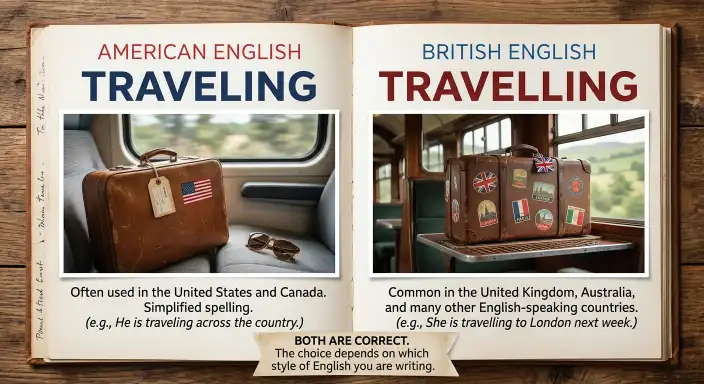
Both “traveling” and “travelling” are correct spellings. The main difference is that traveling is the standard American English spelling, while travelling is the standard British English spelling. Both words have the same meaning and refer to the act of going from one place to another. The correct choice depends on the type of English you are using.
In this guide, you will learn the difference between traveling and travelling, their meanings, spelling rules, pronunciation, common mistakes, and everyday examples.
Quick Answer: Traveling or Travelling?
Both spellings are correct, but they are used in different varieties of English.
| Spelling | English Variety | Correct? |
| Traveling | American English | Yes |
| Travelling | British English | Yes |
Remember: American English usually uses one l, while British English usually uses two l’s in travelling.
Examples:
- American English: I enjoy traveling around the world.
- British English: I enjoy travelling around the world.
Both sentences are correct.
What Does Traveling or Travelling Mean?
Traveling and travelling mean the same thing. They refer to going from one place to another, often for work, education, holidays, or personal reasons.
The word can describe a journey by car, bus, train, plane, or another form of transport.
Traveling as a Verb
Traveling is the ing form of the verb travel. It can describe an action happening now or an activity that someone enjoys or does regularly.
Examples:
- I am traveling to London tomorrow.
- She enjoys traveling with her family.
- We are travelling by train today.
- He loves travelling to new places.
The spelling changes according to the variety of English, but the meaning stays the same.
Traveling as a Noun Like Form
The ing form can also describe the activity of going from place to place.
Examples:
- Traveling can teach us about other cultures.
- Travelling is one of her favorite activities.
- Traveling alone requires careful planning.
In these examples, the word refers to the activity of travel rather than one specific journey.
Traveling vs Travelling: Key Differences
The difference between traveling and travelling is mainly a spelling convention. Their meaning, grammar, and pronunciation are essentially the same.
| Feature | Traveling | Travelling |
| English variety | American English | British English |
| Number of “l” letters before “ing” | One | Two |
| Meaning | Going from place to place | Going from place to place |
| Pronunciation | Same in most contexts | Same in most contexts |
| Correct spelling | Yes | Yes |
| Typical usage | US writing | UK writing |
Neither spelling is universally better. Choose the one that matches your audience and keep it consistent throughout your writing.
British English vs American English
British and American English often use different spelling rules. One common difference is the use of a single l or a double l when adding certain endings to words such as travel.
American English: Traveling
In American English, the final l in travel is usually not doubled before adding ing.
Examples:
- traveling
- traveled
- traveler
Example sentence: My family is traveling across the United States.
British English: Travelling
In British English, the final l is usually doubled before adding endings such as ing and ed.
Examples:
- travelling
- travelled
- traveller
Example sentence: My family is travelling across the United Kingdom.
Which Spelling Should You Use?
Use traveling if you are writing in American English. Use travelling if you are writing in British English.
If you are writing for a British English audience, such as a UK school or publication, travelling is generally the appropriate choice. If your audience follows American English, use traveling.
The most important rule is consistency. Avoid switching between the two spelling systems in the same piece of writing unless you are discussing the difference itself.
Why Are Traveling and Travelling Spelled Differently?
The difference comes from spelling conventions that developed in American and British English.
American English commonly uses one l in words such as traveling and traveled. British English generally doubles the l in travelling and travelled.
This pattern also appears in other words:
| American English | British English |
| Traveling | Travelling |
| Traveled | Travelled |
| Traveler | Traveller |
| Canceling | Cancelling |
| Canceled | Cancelled |
| Labeling | Labelling |
These patterns are common, but English spelling has exceptions. It is best to check a reliable dictionary if you are unsure about a particular word.
How to Pronounce Traveling and Travelling
Both traveling and travelling are usually pronounced the same way. The extra l in the British spelling does not normally create an extra sound.
A common pronunciation in both varieties is:
- IPA: /ˈtrævəlɪŋ/
- Syllables: trav el ing
The word has three syllables.
Pronunciation Examples
- I am traveling to another country.
- She is travelling with her friends.
- They enjoy traveling during the summer.
- We are travelling by bus.
The spelling may differ, but the intended word and meaning remain the same.
Common Mistakes with Travelling and Traveling
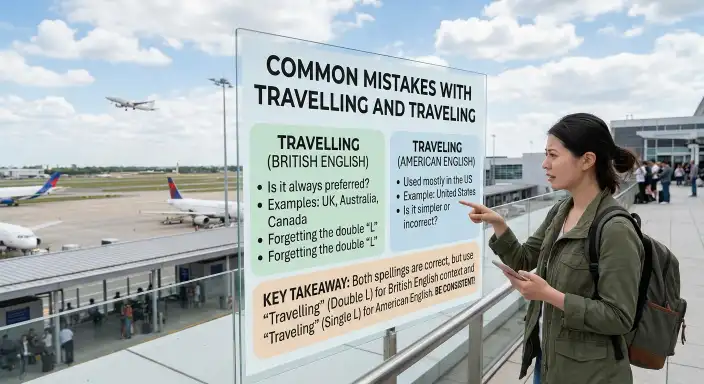
Here are some common errors and ways to avoid them.
Mistake 1: Thinking One Spelling Is Always Wrong
Incorrect claim: Travelling is always wrong.
Correct explanation: Both traveling and travelling are correct. The preferred spelling depends on the variety of English.
Mistake 2: Mixing American and British Spellings
Inconsistent example: We are traveling to London, and we travelled there last year.
More consistent American English: We are traveling to London, and we traveled there last year.
More consistent British English: We are travelling to London, and we travelled there last year.
Mistake 3: Forgetting the Double “l” in British English
American English: She is traveling to Paris.
British English: She is travelling to Paris.
Both are correct in their respective spelling systems.
Mistake 4: Using the Wrong Spelling for Your Audience
If your teacher or publication requires British English, use travelling. If it requires American English, use traveling.
Following the required style helps make your writing clear and consistent.
Everyday Examples of Traveling or Travelling
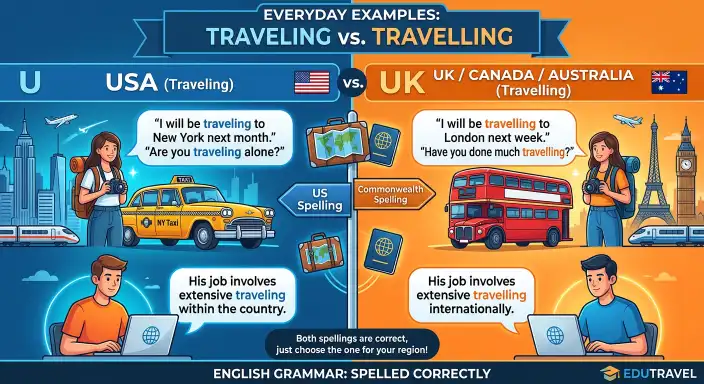
Here are 12 simple examples using both spellings.
- I love traveling to new countries.
- She is travelling to London next week.
- We enjoy traveling by train.
- They are travelling with their children.
- Traveling helps people learn about different cultures.
- He is travelling for business.
- My friend enjoys traveling alone.
- We were travelling when it started to rain.
- Traveling by plane can save time.
- She has always loved travelling abroad.
- They are traveling across the United States.
- My family is travelling around Europe.
The sentences use different spelling conventions, but the meaning is the same.
Related Words: Travel, Traveled, and Traveller
The spelling difference between American and British English also appears in other forms of the word travel.
| American English | British English |
| Travel | Travel |
| Traveling | Travelling |
| Traveled | Travelled |
| Traveler | Traveller |
Travel is the base form in both varieties. The spelling difference becomes visible in certain forms, especially when adding endings.
Examples:
- American: We traveled by car last summer.
- British: We travelled by car last summer.
- American: She is an experienced traveler.
- British: She is an experienced traveller.
Frequently Asked Questions
Is Traveling or Travelling Correct?
Both are correct. Traveling is standard American English, while travelling is standard British English.
What Is the Difference Between Traveling and Travelling?
The difference is spelling. Both words have the same meaning and are generally pronounced the same way.
Is Traveling American or British English?
Traveling is the standard spelling in American English.
Is Travelling American or British English?
Travelling is the standard spelling in British English and is also used in several other varieties that follow British spelling conventions.
Which Spelling Should I Use in an IELTS Essay?
Follow the English spelling style you can use consistently. Both British and American spelling are generally accepted in IELTS writing. Avoid mixing styles unnecessarily.
Is Traveled or Travelled Correct?
Both are correct. Traveled is the standard American spelling, while travelled is the standard British spelling.
Why Does British English Use Two L’s?
British English commonly doubles the final l in words such as travel before adding endings like ing and ed. American English generally does not double it in these forms.
Do Traveling and Travelling Have Different Meanings?
No. They have the same meaning. The difference is regional spelling, not meaning.
Conclusion
Both traveling and travelling are correct English spellings. The main difference is that American English uses traveling, while British English uses travelling. Both words describe the act of going from one place to another and can be used in sentences about holidays, work, education, and everyday journeys.
To choose the right spelling, think about your audience. Use traveling for American English and travelling for British English. Keep the same spelling style throughout your writing to make it clear and professional.
Remember: one “l” for American English, two “l’s” for British English.
Discover More Articles!
Few vs A Few: Meaning, Differences, Grammar Rules, and Examples
Shinning or Shining: Correct Spelling, Meaning, Differences, and Examples
Narcissist or Autistic: What Is the Difference?

Ethan Parker is an English-language writer known for his interest in words, language, and clear communication. His work focuses on making everyday English easier to understand through simple explanations and practical examples.