Have you ever wondered if to use woman or women in a sentence? These two words look almost the same, but they have different meanings and pronunciations. Many English learners confuse them because they differ by only one letter. However, using the wrong word can change the meaning of your sentence.
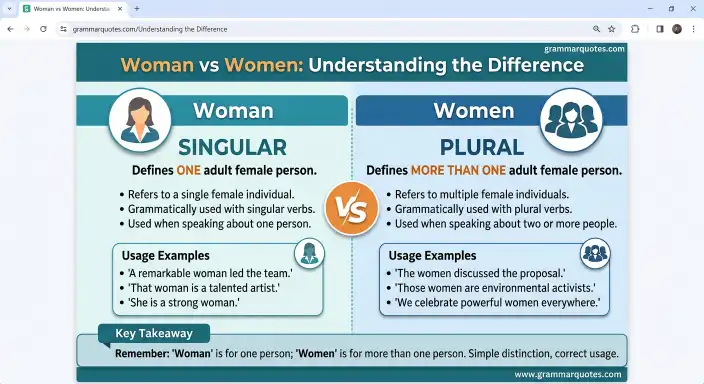
The main difference is simple: woman refers to one adult female, while women refers to two or more adult females. For example, “She is a kind woman” refers to one person. In contrast, “The women are waiting outside” refers to more than one person.
Both words are correct English words. Neither is a misspelling of the other. The key is to understand if you are talking about one person or several people.
In this guide, you will learn the meaning, pronunciation, grammar rules, history, and correct usage of woman and women. You will also find everyday examples, common mistakes, and answers to frequently asked questions. By the end, you will know exactly when to use each word.
Quick Answer: Woman vs Women
Woman is the singular noun, and women is its plural form.
| Word | Meaning | Pronunciation | Example |
| Woman | One adult female | /ˈwʊmən/ | She is a talented woman. |
| Women | Two or more adult females | /ˈwɪmɪn/ | The women are talented. |
Easy rule to remember:
- Use woman when talking about one person.
- Use women when talking about more than one person.
Examples:
- Correct: A woman is standing near the door.
- Correct: Three women are standing near the door.
Woman: Definition and Meaning
The word woman is a noun that refers to one adult female human being. It is used when talking about a single person.
Examples of Woman in Sentences
- My mother is a strong woman.
- A woman asked me for directions.
- She wants to become a successful businesswoman.
- Every woman deserves respect.
- The woman in the blue dress is my teacher.
In each sentence, woman refers to one person.
What Does Woman Mean in Everyday English?
In everyday English, woman is used when describing an individual, discussing someone’s role, or referring to a particular person.
For example:
- “She is an intelligent woman.”
- “That woman works at the hospital.”
- “A woman called the office this morning.”
Remember that woman is singular, so it usually takes singular verbs such as is, has, and does.
Examples:
- The woman is happy.
- The woman has a new job.
- The woman does her work carefully.
Women: Definition and Meaning
The word women is the plural form of woman. It refers to two or more adult female human beings.
Examples of Women in Sentences
- The women are talking in the garden.
- Many women work in healthcare.
- These women are my friends.
- The women have completed their training.
- Several women attended the meeting.
In each sentence, women refers to more than one person.
What Does Women Mean in Everyday English?
The word women is commonly used when talking about groups, communities, families, professions, or several individuals.
For example:
- “The women are preparing dinner.”
- “Many women study computer science.”
- “Those women work at the university.”
Remember that women is plural, so it usually takes plural verbs such as are, have, and do.
Examples:
- The women are ready.
- The women have important responsibilities.
- The women do their work well.
The Main Differences Between Women and Woman
Although the words have similar spellings, their meanings and grammatical uses are different.
| Feature | Woman | Women |
| Number | Singular | Plural |
| Meaning | One adult female | Two or more adult females |
| Pronunciation | /ˈwʊmən/ | /ˈwɪmɪn/ |
| Example | A woman is here. | Two women are here. |
| Common verb | Is, has, does | Are, have, do |
| Demonstratives | This woman, that woman | These women, those women |
| Article use | A woman, the woman | The women, some women |
1. Singular vs Plural
The most important difference is the number of people.
- Woman: One woman is reading.
- Women: Four women are reading.
2. Pronunciation Difference
The spelling changes only slightly, but the vowel sound changes too.
- Woman: Sounds like “WUHM uhn.”
- Women: Sounds like “WIM in.”
The first syllable of woman sounds like the vowel in “book,” while the first syllable of women sounds like the vowel in “sit.”
3. Verb Agreement
Use singular verbs with woman and plural verbs with women.
- Correct: The woman is busy.
- Incorrect: The woman are busy.
- Correct: The women are busy.
- Incorrect: The women is busy.
Woman vs Women: British and American English
Both woman and women are standard in British and American English. Their meanings and basic grammatical rules do not change between these varieties.
| Feature | British English | American English |
| Singular | Woman | Woman |
| Plural | Women | Women |
| Singular pronunciation | /ˈwʊmən/ | /ˈwʊmən/ |
| Plural pronunciation | /ˈwɪmɪn/ | /ˈwɪmɪn/ |
| Spelling difference | None | None |
Pronunciation can vary by accent, but the spelling and singular versus plural distinction remain the same.
Which Word Should You Use: Woman or Women?
Choosing the correct word becomes easy when you count the people you are talking about.
Use Woman for One Person
Use woman when referring to a single adult female.
Examples:
- She is a wonderful woman.
- I met a woman at the library.
- The woman is waiting for her friend.
- My sister is a confident woman.
Use Women for More Than One Person
Use women when referring to two or more adult females.
Examples:
- The women are studying together.
- Five women joined the team.
- These women are doctors.
- Many women enjoy reading books.
Use the Correct Articles and Demonstratives
The article a is used with the singular countable noun woman, not with the plural noun women.
- Correct: A woman is speaking.
- Incorrect: A women is speaking.
- Correct: Some women are speaking.
- Incorrect: Some woman are speaking.
Similarly, use this and that with singular nouns, and these and those with plural nouns.
- This woman is my aunt.
- That woman is a teacher.
- These women are my classmates.
- Those women are visiting us.
Common Mistakes When Using Women and Woman
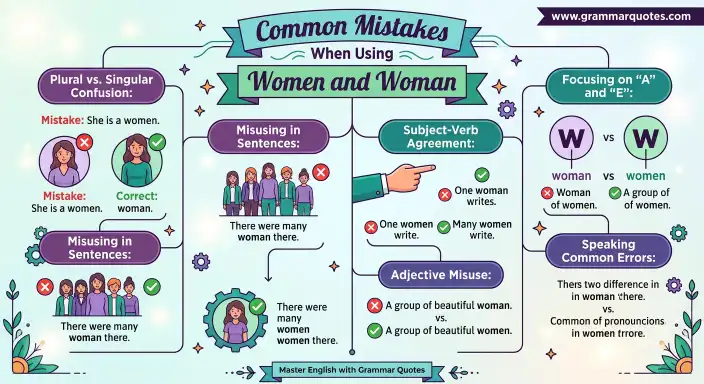
English learners often confuse these words because their spelling is similar. Here are common mistakes and their corrections.
Mistake 1: Using Women for One Person
Incorrect: She is a kind women.
Correct: She is a kind woman.
Why? The sentence refers to one person, so the singular form woman is required.
Mistake 2: Using Woman for Several People
Incorrect: The woman are waiting outside.
Correct: The women are waiting outside.
Why? The sentence refers to multiple people, so use the plural noun women.
Mistake 3: Using the Wrong Verb
Incorrect: The women is very helpful.
Correct: The women are very helpful.
Why? Women is plural and normally takes a plural verb.
Mistake 4: Using “A” Before Women
Incorrect: A women called me yesterday.
Correct: A woman called me yesterday.
Why? The article a is used with a singular countable noun.
Mistake 5: Confusing Spelling and Pronunciation
Some learners pronounce woman and women the same way. However, their first vowel sounds are different in standard pronunciation.
- Woman: /ˈwʊmən/
- Women: /ˈwɪmɪn/
Practising both words aloud can help you remember the difference.
Woman vs Women: Everyday Examples
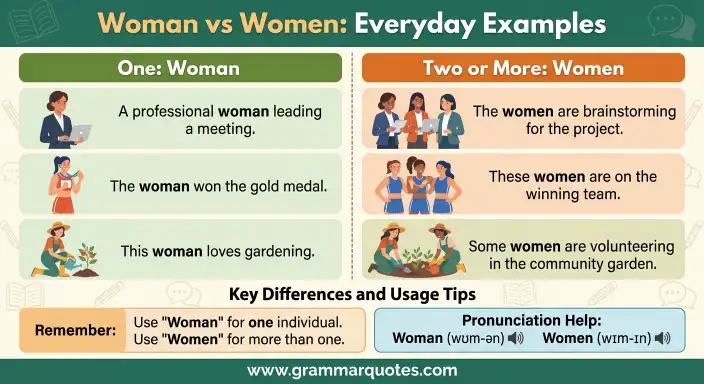
Here are 20 examples to help you understand how to use both words naturally.
Examples Using Woman
- She is a brave woman.
- A woman entered the classroom.
- The woman is my neighbour.
- I saw a woman at the market.
- Every woman has her own story.
- The woman works as a nurse.
- She is an honest woman.
- A woman helped the child.
- That woman speaks English fluently.
- My grandmother is a wise woman.
Examples Using Women
- The women are sitting together.
- Many women work in education.
- Two women visited our house.
- These women are very friendly.
- The women have finished their work.
- Several women attended the event.
- Those women are my teachers.
- Women play important roles in society.
- The women are waiting for the bus.
- Three women joined the discussion.
Woman vs Women: Quick Comparison Table
| Sentence | Correct Word | Reason |
| She is a kind ___ . | Woman | One person |
| The ___ are talking. | Women | More than one person |
| A ___ called me. | Woman | Singular noun after “a” |
| Five ___ arrived. | Women | Plural noun after a number greater than one |
| This ___ is my aunt. | Woman | “This” refers to one person |
| These ___ are my friends. | Women | “These” refers to multiple people |
| The ___ is working. | Woman | Singular verb “is” |
| The ___ are working. | Women | Plural verb “are” |
Word Origin and History of Woman and Women
The words woman and women have a long history in English.
The singular word woman developed from Old English wīfmann, a term formed from wīf (woman or wife) and mann (person or human being). Over time, its spelling and pronunciation changed into the modern form woman.
The word women developed as the plural form of woman. English spelling changed over the centuries, but the plural form kept a different vowel sound from the singular form.
Today, both words are standard English nouns. Their spelling reflects the historical development of the language rather than a simple rule in which adding s creates the plural.
Word Formation and Grammar
Woman and women are different grammatical forms of the same noun.
| Grammatical Form | Example |
| Singular | A woman is speaking. |
| Plural | Two women are speaking. |
| Singular possessive | The woman’s bag is black. |
| Plural possessive | The women’s bags are black. |
Notice that the plural possessive is spelled women’s, not womans’.
Examples:
- The woman’s phone is on the table. (One woman)
- The women’s team won the match. (A team of women)
The word woman can also appear in compound words, such as businesswoman and chairwoman. Their plural forms depend on the compound’s usage; for example, businesswomen and chairwomen.
Woman vs Women: Key Takeaways
- Woman means one adult female.
- Women means two or more adult females.
- Woman is singular; women is plural.
- Woman is pronounced /ˈwʊmən/.
- Women is pronounced /ˈwɪmɪn/.
- Use is, has, and does with singular woman when the subject is singular.
- Use are, have, and do with plural women when the subject is plural.
- Both spellings are correct in British and American English.
- Use a woman, not a women.
- Use these women, not these woman.
People Also Ask About Woman vs Women
1. Is It Woman or Women?
Both words are correct. Use woman for one adult female and women for two or more adult females.
2. What Is the Plural of Woman?
The plural of woman is women. It is an irregular plural because the word does not form its plural by simply adding s.
3. How Do You Pronounce Woman and Women?
Woman is pronounced /ˈwʊmən/, while women is pronounced /ˈwɪmɪn/. Their first vowel sounds are different.
4. Is “Women” Singular or Plural?
Women is plural. It refers to two or more adult females and usually takes plural verbs such as are and have.
5. Can I Say “A Women”?
No. The correct phrase is “a woman” because a is used before a singular countable noun.
6. What Is the Difference Between Woman’s and Women’s?
Woman’s is the singular possessive form and refers to something belonging to one woman. Women’s is the plural possessive form and refers to something belonging to or associated with multiple women.
Examples:
- The woman’s coat is red.
- The women’s coats are red.
Frequently Asked Questions (FAQs)
Is Woman a Correct English Word?
Yes. Woman is a standard English word used for one adult female human being.
Is Women a Correct English Word?
Yes. Women is the standard plural form of woman and refers to more than one adult female.
Why Is Women Not Spelled Womans?
Women is an irregular plural inherited from the historical development of English. Unlike regular nouns such as book/books, it does not form its plural by adding s.
Which Is Correct: “Woman Are” or “Women Are”?
“Women are” is correct when you are talking about multiple people. For one person, use “a woman is.”
Is “Women” the Same as “Woman”?
No. Both words refer to adult females, but woman is singular and women is plural. They cannot usually replace each other in a sentence.
What Is the Difference Between Woman and Female?
Woman is a noun referring to an adult female human being. Female can be an adjective or a noun and is used in broader biological and social contexts. When referring to an adult person in ordinary conversation, woman is often the more natural noun.
Conclusion
Understanding woman vs women is an important step toward improving your English grammar and writing. Although the words look similar, they have different grammatical uses. Woman refers to one adult female, while women refers to two or more adult females. The main rule is to check if you are talking about one person or a group.
For example, you should write “A woman is waiting outside” when referring to one person. If several people are waiting, write “The women are waiting outside.” Remember that singular woman normally takes singular verbs, while plural women takes plural verbs. Also, pay attention to pronunciation: woman sounds like “WUHM uhn,” while women sounds like “WIM in.”
Neither word is wrong. The correct choice depends on the meaning of your sentence. Practise using both words in everyday conversations, school assignments, and English writing. With regular practice, you will learn to use woman and women correctly and confidently.
Discover More Articles!
Definitely or Definately: Correct Spelling, Meaning, and Examples
Motorhome or RV: What Is the Difference?(2026)
Color or Colour: Correct Spelling, Meaning, and Examples

Ethan Parker is an English-language writer known for his interest in words, language, and clear communication. His work focuses on making everyday English easier to understand through simple explanations and practical examples.