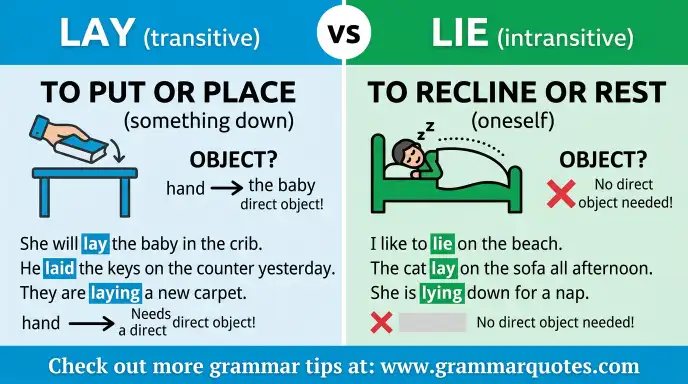
Lay vs lie is a common English grammar confusion because both words describe putting something down or resting in a position. However, lay usually means to put something or someone down, while lie means to rest or recline. The biggest challenge is that their past tense forms can be confusing: the past tense of lay is laid, while the past tense of lie is lay.
For example, “I lay the book on the table” means I put the book there, while “I lie on the sofa” means I rest on it. Yesterday, “I laid the book on the table,” but “I lay on the sofa.” Understanding the difference between these words can improve your writing, speaking, and everyday communication.
In this guide, you will learn the meanings of lay and lie, their verb forms, the grammar rules that separate them, common mistakes, and practical examples. if you are learning English as a second language or improving your grammar, these simple explanations will help you choose the correct word with confidence.
Quick Answer: Lay vs Lie
| Word | Meaning | Example |
| Lay | To put something down; usually takes an object | Please lay the book on the desk. |
| Lie | To rest or recline; does not take a direct object | I want to lie on the bed. |
| Laid | Past tense of lay | She laid the keys on the table. |
| Lay | Past tense of lie | He lay on the sofa yesterday. |
| Lain | Past participle of lie | She has lain in bed all morning. |
| Laid | Past participle of lay | I have laid the clothes out. |
Easy rule: If someone puts something down, use lay. If someone rests or reclines, use lie.
What Does Lay Mean?
Lay is a verb that means to put, place, or set something down carefully. It usually needs a direct object, which means you must identify what is being placed.
For example, in “Lay your phone on the table,” the word phone is the object. Someone is placing the phone on the table.
Examples of Lay in Sentences
- Please lay your bag beside the door.
- She lays the baby in the crib.
- I laid my notebook on the desk.
- They are laying new tiles in the kitchen.
- He has laid the documents on the counter.
In each sentence, someone puts something in a particular place.
Verb Forms of Lay
| Verb form | Word | Example |
| Base form | Lay | I lay the book down. |
| Third person singular | Lays | She lays the book down. |
| Present participle | Laying | He is laying the book down. |
| Simple past | Laid | He laid the book down. |
| Past participle | Laid | He has laid the book down. |
Remember that lay, laid, laid are the three main forms of this verb.
What Does Lie Mean?
Lie is a verb that means to rest, recline, or be in a horizontal position. Unlike lay, it normally does not need a direct object.
For example, in “I lie on the bed,” the person is resting. The person is not putting another object somewhere.
Examples of Lie in Sentences
- I want to lie down for a while.
- The cat lies beside the window.
- She is lying on the sofa.
- He lay on the grass yesterday.
- They have lain in bed for hours.
In these examples, the subject is resting or remaining in a position.
Verb Forms of Lie
| Verb form | Word | Example |
| Base form | Lie | I lie down after lunch. |
| Third person singular | Lies | He lies on the sofa. |
| Present participle | Lying | She is lying on the bed. |
| Simple past | Lay | He lay down yesterday. |
| Past participle | Lain | He has lain there for an hour. |
The main forms are lie, lay, lain when lie means to recline. These forms are different from the verb lay.
Important: This guide focuses on lie meaning “to rest.” The separate verb lie, meaning “to tell something untrue,” has different forms: lie, lied, lied.
Lay vs Lie: Main Differences
The key difference is if the verb takes a direct object.
1. Lay Takes an Object
Use lay when someone puts something down.
- Correct: Lay the blanket on the bed.
- Incorrect: Lie the blanket on the bed.
The blanket is the object being placed.
2. Lie Does Not Take a Direct Object
Use lie when a person or animal rests or reclines.
- Correct: I need to lie down.
- Incorrect: I need to lay down.
In standard grammar, lie down is correct when you mean that you will rest yourself. In casual conversation, some speakers use lay down this way, but formal writing generally distinguishes the two.
3. Their Past Tenses Are Different
The past tense of lay is laid. The past tense of lie meaning “to rest” is lay.
- Present: I lie on the couch.
- Past: I lay on the couch yesterday.
- Present: I lay the book on the desk.
- Past: I laid the book on the desk yesterday.
This is the part that causes the most confusion.
Lay vs Lie: Grammar Rules
Learning a few basic rules makes it easier to use these verbs correctly.
Rule 1: Ask “What?” After the Verb
If the sentence answers “what?” with a direct object, lay is usually the correct verb.
- She laid what? The keys.
- He is laying what? The carpet.
- They lay what? The books.
If there is no direct object and the meaning is resting or reclining, use lie.
- I want to lie down.
- The dog lies near the door.
- She lay on the grass.
Rule 2: Use Laid for the Past of Lay
When describing a completed action of putting something down, use laid.
- Present: I lay my clothes on the chair.
- Past: I laid my clothes on the chair.
- Present perfect: I have laid my clothes on the chair.
Do not use lay as the past tense of this particular verb.
Rule 3: Use Lay as the Past of Lie
When describing resting in the past, use lay.
- Present: I lie in bed.
- Past: I lay in bed last night.
- Present perfect: I have lain in bed for two hours.
Although lay can be a present tense verb meaning “put something down,” it is also the past tense of lie meaning “rest.”
Rule 4: Use Lain After Have, Has, or Had
When lie means to rest, use lain after a form of have.
- Correct: She has lain on the sofa all afternoon.
- Correct: He had lain there before anyone noticed.
- Incorrect: She has lay on the sofa all afternoon.
For the verb lay, use laid after have, has, or had.
- Correct: She has laid the papers on the desk.
- Incorrect: She has lain the papers on the desk.
Lie vs Lay: Examples in Everyday English

These everyday examples show how the words work in common situations.
Examples Using Lay
- Please lay your jacket on the chair.
- I laid my phone beside my laptop.
- She lays the plates on the dining table.
- The worker is laying bricks outside.
- He laid the baby gently in the crib.
- They have laid the foundation of the building.
- Lay the cards face down.
- I am laying the books in alphabetical order.
- She laid the flowers beside the photograph.
- He has laid his school uniform on the bed.
Examples Using Lie
- I like to lie on the sofa after school.
- The dog lies under the table.
- She is lying on the grass.
- He lay in bed until noon yesterday.
- The village lies near the river.
- I have lain awake for an hour.
- The book lies open on the desk.
- They lay on the beach and watched the clouds.
- The road lies between two hills.
- She had lain there before her friend arrived.
Notice that lie can also describe where something is located, as in “The village lies near the river.” It does not always mean a person is sleeping or resting.
Lay vs Lie: Comparison Table
| Feature | Lay | Lie (to recline) |
| Main meaning | Put something down | Rest or be in a position |
| Direct object | Usually required | Not required |
| Present form | Lay | Lie |
| Third person form | Lays | Lies |
| ing form | Laying | Lying |
| Past tense | Laid | Lay |
| Past participle | Laid | Lain |
| Example | I laid the book down. | I lay down yesterday. |
This table is useful when you need to check a sentence quickly.
Lay vs Lie in British and American English
The basic grammar rules for lay and lie are the same in British and American English. Both varieties distinguish between putting something down and resting or reclining.
However, in informal speech, some speakers use lay down when they mean lie down. You may hear expressions such as “I’m going to lay down” in everyday conversation.
In formal writing, schoolwork, and grammar tests, it is safer to follow the standard distinction:
- Lay down the book: Put the book down.
- Lie down: Rest your body.
- I laid down the book: I placed the book down in the past.
- I lay down yesterday: I rested yesterday.
Neither British nor American English changes the standard verb forms simply because of the variety of English being used.
Common Mistakes With Lay and Lie
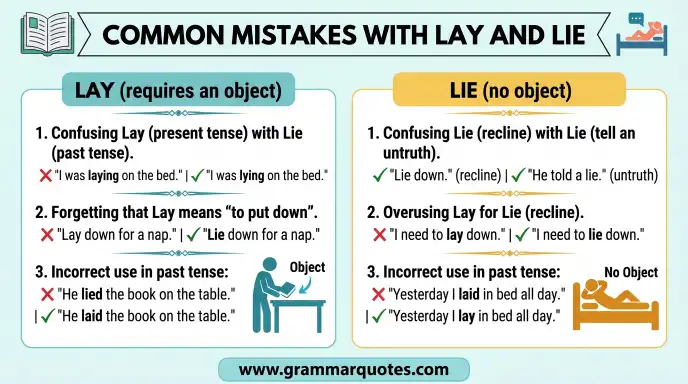
Many learners confuse these verbs because their forms overlap. Here are some common mistakes and their corrections.
Mistake 1: “I Am Going to Lay Down”
Incorrect in standard grammar: I am going to lay down.
Correct: I am going to lie down.
Use lie when you mean that you will rest yourself.
Mistake 2: “I Have Layed the Book Down”
Incorrect: I have layed the book down.
Correct: I have laid the book down.
Layed is not the standard past tense form of this verb. Use laid.
Mistake 3: “Yesterday, I Lied on the Bed”
Incorrect for the meaning of resting: Yesterday, I lied on the bed.
Correct: Yesterday, I lay on the bed.
Lied is the past tense of lie when it means telling something untrue. For resting, the past tense is lay.
Mistake 4: “She Has Lay in Bed All Day”
Incorrect: She has lay in bed all day.
Correct: She has lain in bed all day.
After has, use the past participle lain when describing rest.
Mistake 5: “Lay the Baby Down” vs “Lie the Baby Down”
Correct: Lay the baby down.
The baby is the object being placed, so lay is the correct verb.
How to Remember Lay vs Lie Easily
Use these simple memory tricks to choose the right word.
- Lay = place: You lay an object somewhere.
- Lie = recline: You lie down to rest.
- Laid = placed in the past: I laid the book on the desk.
- Lay = rested in the past: I lay on the sofa yesterday.
- Lain = have rested: I have lain in bed for an hour.
A helpful question is: Am I putting something down, or am I resting?
If you are putting something down, choose lay. If you are resting, choose lie in the present tense.
People Also Ask About Lay vs Lie
1. Is It Lay or Lie Down?
Use lie down when you mean to rest your body. For example, “I need to lie down because I feel tired.” Use lay down when you are placing something down, as in “Lay the bag down.”
2. Is It “I Lay Down” or “I Lied Down”?
Use “I lay down” when describing resting in the past. Lied refers to telling something untrue, not reclining.
3. Is It Laid or Layed?
Laid is the correct past tense and past participle of lay. Layed is a nonstandard spelling in ordinary modern English.
4. What Is the Past Tense of Lie?
When lie means to rest or recline, its past tense is lay. For example, “I lay on the sofa yesterday.”
5. Is It “I Have Laid Down” or “I Have Lain Down”?
Use “I have lain down” when you mean that you have rested or reclined. Use laid when an object has been placed somewhere, as in “I have laid the blanket down.”
6. Can Lay and Lie Mean the Same Thing?
They can describe similar situations, but their standard grammatical uses are different. Lay means to put something down, while lie means to rest or occupy a position. Informal speech sometimes mixes them.
Frequently Asked Questions
What Is the Main Difference Between Lay and Lie?
Lay means to put something down and usually takes a direct object. Lie means to rest or recline and does not take a direct object in this sense.
What Are the Three Forms of Lay?
The three main forms are lay, laid, laid. For example: “I lay the book down,” “I laid it down yesterday,” and “I have laid it down.”
What Are the Three Forms of Lie?
When lie means to recline, its three main forms are lie, lay, lain. For example: “I lie down,” “I lay down yesterday,” and “I have lain down.”
Why Is Lay the Past Tense of Lie?
English has irregular verbs whose forms do not follow the usual pattern of adding ed. The verb lie, meaning to rest, changes to lay in the simple past and lain in the past participle.
Is “Lay Down and Rest” Grammatically Correct?
It depends on the intended meaning. If you are telling someone to rest their body, “Lie down and rest” is the standard form. If you are telling someone to put an object down before resting, lay down may be correct with that object.
How Can I Avoid Confusing Lay and Lie?
Remember the difference between placing and resting. Ask if the verb has a direct object. If you are placing something, use lay. If you are resting, use lie in the present, lay in the past, and lain after have, has, or had.
Conclusion
Understanding lay vs lie becomes easier when you focus on the action and the verb forms. Lay means to put something down and usually requires a direct object, while lie means to rest, recline, or remain in a position. The most important forms to remember are lay, laid, laid for the verb meaning “to place” and lie, lay, lain for the verb meaning “to rest.”
For example, you can lay your book on a table, lie on your bed, lay the book down yesterday, or say that you lay in bed yesterday. These differences may seem confusing at first, but regular practice will help you use the correct word naturally.
When you are unsure, ask yourself if you are placing something somewhere or resting yourself. With this simple rule and the examples in this guide, you can avoid common mistakes and improve your everyday English, school assignments, and professional writing.
Discover More Articles!
Practice or Practise: Correct Spelling, Meaning, and Examples
Motorhome or RV: What Is the Difference?(2026)
Color or Colour: Correct Spelling, Meaning, and Examples

Ethan Parker is an English-language writer known for his interest in words, language, and clear communication. His work focuses on making everyday English easier to understand through simple explanations and practical examples.