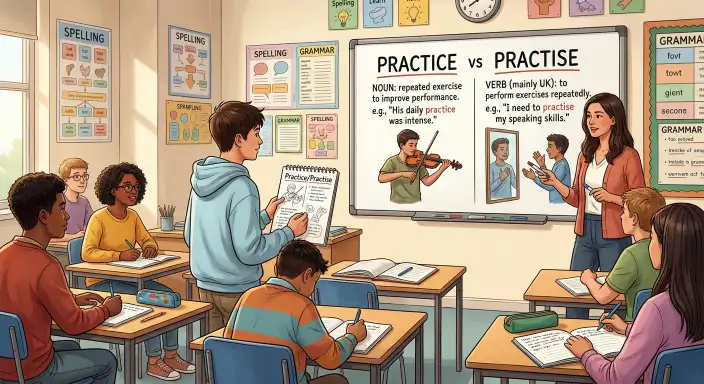
Practice and practise are both correct spellings, but their use depends on the type of English you follow. In American English, practice is used as both a noun and a verb. In British English, practice is a noun, while practise is a verb.
Both words are related to learning, training, or doing something regularly to improve a skill. Understanding the difference between practice and practise can help you write more clearly and avoid common spelling mistakes.
Quick Answer: Practice or Practise?
The correct choice depends on if you are using American or British English.
- Practice: Used as a noun in both American and British English.
- Practise: Used as a verb in British English.
- American English: Uses practice for both the noun and the verb.
- British English: Uses practice for the noun and practise for the verb.
Examples:
- Noun: I need more practice before the exam.
- American verb: I practice English every day.
- British verb: I practise English every day.
The key rule is simple: American English uses practice for both forms, while British English distinguishes between the noun and the verb.
What Does Practice Mean?
Practice is a noun that means repeated activity or training to improve a skill. It can also refer to a usual way of doing something or the work of a professional, such as a doctor or lawyer.
In American English, practice can also be used as a verb.
Examples of Practice as a Noun
- Regular practice helps students improve their English.
- Football practice starts at four o’clock.
- She needs more practice before her driving test.
- Good study practices can help students learn better.
- The doctor has a busy medical practice.
Examples of Practice as a Verb in American English
- I practice speaking English every morning.
- He practices the piano after school.
- They practice football twice a week.
- She practices writing to improve her grammar.
- We practice our presentation before the event.
In these examples, the word practice describes training or repeated activity.
What Does Practise Mean?
Practise is a verb commonly used in British English. It means to do something repeatedly to improve your ability or become more skilled.
It has the same meaning as the American English verb practice.
Examples of Practise in Sentences
- I practise English every day.
- She practises the piano after school.
- They practise football in the evening.
- He practised his speech before the meeting.
- We are practising for the school competition.
In British English, the spelling changes according to the verb form:
- Present: practise
- Third person singular: practises
- Past tense: practised
- Present participle: practising
Remember that practise is a verb, not the standard British English noun.
Practice vs Practise: Key Differences
| Feature | Practice | Practise |
| American English noun | Correct | Not used |
| American English verb | Correct | Not used |
| British English noun | Correct | Not used |
| British English verb | Not standard | Correct |
| Meaning | Training or repeated activity; also a verb in American English | To train or repeat an activity |
| Past tense in British English | Not standard for the verb | Practised |
| ing form in British English | Not standard for the verb | Practising |
Easy rule: In British English, use practice for a thing or activity (noun) and practise for an action (verb). In American English, use practice for both.
American English vs British English
American and British English sometimes use different spellings for words with similar meanings. Practice and practise are a good example.
American English
American English uses practice as both a noun and a verb.
Examples:
- I need more practice.
- I practice English every day.
- She practices the piano.
- He practiced for the test.
- They are practicing for the match.
British English
British English uses practice as a noun and practise as a verb.
Examples:
- I need more practice.
- I practise English every day.
- She practises the piano.
- He practised for the test.
- They are practising for the match.
The meaning stays the same. Only the spelling and grammatical form change.
How to Pronounce Practice and Practise
The words practice and practise are usually pronounced the same way in English.
- Practice: /ˈpræk.tɪs/
- Practise: /ˈpræk.tɪs/
The word has two syllables: PRAC tice. The stress falls on the first syllable.
The ending sounds like “iss,” not “ice.” Although the spelling changes, the pronunciation does not normally change.
When Should You Use Practice or Practise?
Choose the correct spelling by identifying the role of the word and the type of English you are using.
Use Practice When:
- You need a noun in American or British English.
- You are writing in American English and need a verb.
- You are talking about training or repeated activity.
- You are referring to a professional’s business or work.
Examples:
- I need more practice.
- I practice English every day. (American English)
- The doctor has a private practice.
Use Practise When:
- You are writing in British English.
- You are using the word as a verb.
- You are describing an action that helps someone improve a skill.
Examples:
- I practise English every day.
- She practises the guitar.
- They practised for the competition.
- We are practising our presentation.
Common Mistakes with Practise and Practice
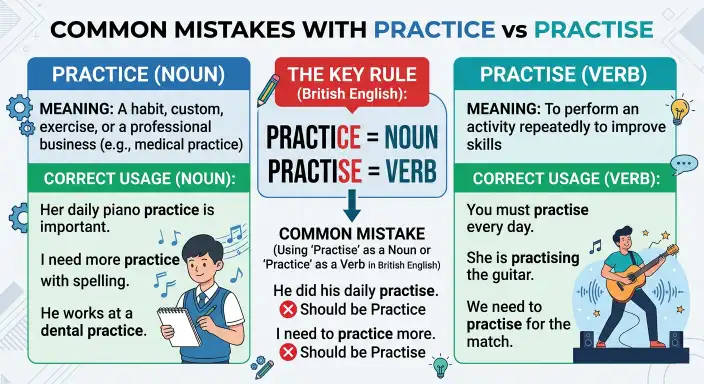
Many writers confuse these words because they have the same pronunciation. Here are some common mistakes to avoid.
1. Using Practise as a British English Noun
Incorrect: I need more practise.
Correct: I need more practice.
In British English, practice is the noun.
2. Using Practice as a British English Verb
In standard British English:
Incorrect: I practice English every day.
Correct: I practise English every day.
However, the first sentence is correct in American English.
3. Forgetting the Verb Forms
In British English, the verb forms are:
- Practise
- Practises
- Practised
- Practising
In American English, the corresponding forms are:
- Practice
- Practices
- Practiced
- Practicing
4. Assuming One Spelling Is Always Wrong
Neither spelling is always wrong. The correct form depends on the English variety and if the word is being used as a noun or a verb.
Everyday Examples of Practice and Practise
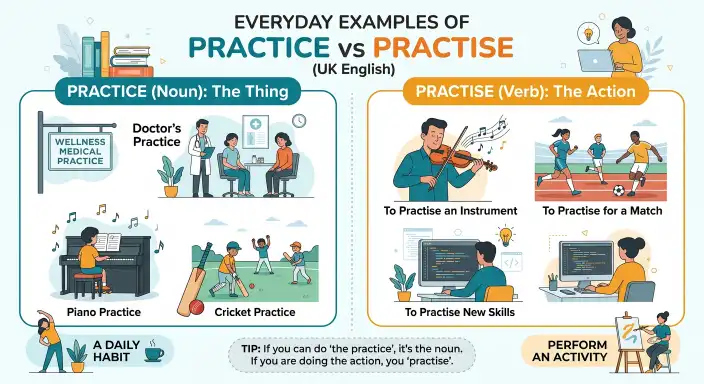
| American English | British English |
| I practice English every day. | I practise English every day. |
| She practices the piano. | She practises the piano. |
| He practiced for the exam. | He practised for the exam. |
| They are practicing football. | They are practising football. |
| I need more practice. | I need more practice. |
| Good practice improves your skills. | Good practice improves your skills. |
Notice that the noun practice stays the same in both varieties of English.
Synonyms of Practice and Practise
You can use different words depending on the meaning of the sentence.
Synonyms for Practice as a Noun
- Training
- Rehearsal
- Preparation
- Exercise
- Repetition
- Experience
Synonyms for Practise as a Verb
- Train
- Rehearse
- Exercise
- Prepare
- Repeat
- Learn
- Improve
Examples:
- Original: I practise speaking English every day.
- Alternative: I train my speaking skills every day.
- Original: She needs more practice before the performance.
- Alternative: She needs more rehearsal before the performance.
These words are related, but they are not interchangeable in every sentence.
Frequently Asked Questions
1. Is Practice or Practise Correct?
Both are correct. In American English, practice is used as both a noun and a verb. In British English, practice is the noun and practise is the verb.
2. Is Practice American or British English?
Practice is used in both American and British English as a noun. It is also the standard spelling for the verb in American English.
3. Is Practise British English?
Yes. Practise is the standard British English spelling of the verb meaning to train or repeat an activity to improve a skill.
4. Is It Practise or Practice English?
In American English, write practice English. In British English, write practise English.
5. What Is the Past Tense of Practise?
The British English past tense is practised. In American English, the past tense is practiced.
6. Is It Practising or Practicing?
Both are correct in their respective spelling systems. Practising is British English, while practicing is American English.
7. Is Practice a Noun or a Verb?
It can be both. In American English, practice is a noun and a verb. In British English, practice is a noun, while practise is a verb.
8. How Can I Remember the Difference Between Practice and Practise?
If you use British English, remember that the noun ends in ice and the verb ends in ise. If you use American English, use practice for both.
Conclusion
The difference between practice or practise depends on the type of English you are using. In American English, practice works as both a noun and a verb. In British English, practice is a noun, while practise is a verb.
For example, “I need more practice” is correct in both varieties. However, Americans write “I practice every day,” while British writers commonly write “I practise every day.” Learning this simple rule will help you avoid spelling mistakes and improve your writing.
Discover More Articles!
Few vs A Few: Meaning, Differences, Grammar Rules, and Examples
Narcissist or Autistic: What Is the Difference?
Shinning or Shining: Correct Spelling, Meaning, Differences, and Examples

Ethan Parker is an English-language writer known for his interest in words, language, and clear communication. His work focuses on making everyday English easier to understand through simple explanations and practical examples.