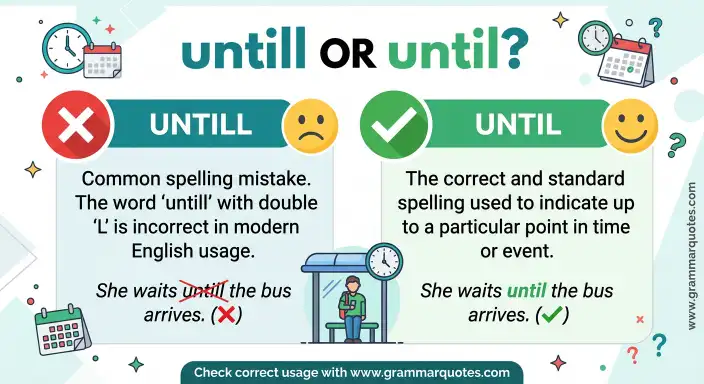
Until is the correct spelling. Untill is a common spelling mistake and should not be used in formal or informal writing. The confusion often happens because English has many words that double their final consonant when a suffix is added, such as running and stopped. However, until does not follow that pattern.
Knowing the correct spelling helps you write clearer emails, school assignments, business documents, blog posts, and social media updates. It also helps you avoid simple grammar mistakes that can affect the quality of your writing.
In this guide, you will learn the difference between until and untill, what the correct word means, how to use it in sentences, and why the extra L is incorrect. You will also find practical examples, common mistakes, regional usage advice, and answers to frequently asked questions.
Untill or Until: Which Is Correct? Quick Answer
Until is the correct spelling in standard English. It means up to a particular time, event, or point. Untill is a misspelling and should be avoided.
Examples:
- Correct: I will wait until Monday.
- Correct: The shop stays open until 9 p.m.
- Incorrect: Please finish the work untill Friday.
Remember this simple rule: Until has one L at the end, not two.
Untill or Until: Quick Answer
When choosing between untill and until, always use until. The word works as a preposition or a conjunction. It helps show when an action ends or how long a situation continues.
For example:
- We studied until midnight.
- Wait here until I return.
- The offer is available until December 31.
There is no standard spelling rule that makes untill correct in these sentences. Although you may see it in online posts, messages, or older informal writing, the accepted modern spelling is until.
What Does Until Mean?
Until means up to a specific time, event, or point. It shows that an action or situation continues and then stops, changes, or reaches a stated limit.
Definition of Until
In everyday English, until is used to describe the time before something happens or the point at which something ends.
For example:
- I will stay here until noon.
- She worked until the office closed.
- Do not open the door until the bell rings.
In the first sentence, the speaker will remain in the same place up to noon. In the second, the work continues until the office closes. In the third, the door should remain closed before the bell rings.
Until as a Preposition
A preposition connects a noun or noun phrase to the rest of a sentence. Until can show the endpoint of a period of time.
Examples:
- The library is open until Friday.
- We waited until sunset.
- The deadline has been extended until next week.
Here, until comes before a time expression.
Until as a Conjunction
A conjunction connects parts of a sentence. Until can introduce an event or action that marks the end of another action.
Examples:
- Stay inside until the rain stops.
- I did not understand the lesson until the teacher explained it.
- Keep practising until you feel confident.
In these sentences, until introduces a clause containing a subject and a verb.
Until vs. Till
Until and till have the same basic meaning. Both can refer to a time or event up to which something continues.
Examples:
- I will wait until six o’clock.
- I will wait till six o’clock.
Both sentences are correct. Until is often preferred in formal writing, while till is common in everyday speech and informal writing.
Do not confuse till with ’til. The latter is a shortened form used informally, but till itself is an established English word.
The Origin of Until
The word until has a long history in English. It developed from earlier English forms built around till, a word used to express a limit in time.
The word till has roots in Old English. The form until developed as a longer expression with the prefix un attached to till. Its history does not mean that modern writers should spell it untill.
Over time, until became the standard spelling in modern English. The spelling untill is generally treated as an error rather than a separate word with a different meaning.
Why Do People Write Untill?
There are several reasons why people add an extra L:
- Double letter confusion: Words such as filling, calling, and spelling contain double Ls.
- Pronunciation habits: The spoken word does not make the spelling difference obvious.
- Typing quickly: People may repeat a letter by mistake.
- Visual confusion: The two spellings look almost identical.
The key point is that until is not a word that takes a second L at the end. Learn its spelling as a whole rather than applying a double letter rule.
British English vs American English
The spelling of until is the same in British and American English. Unlike words such as colour and color, this word does not have separate standard spellings for these regions.
| British English | American English | Example |
| Until | Until | Wait until tomorrow. |
| Till | Till | The store is open till five. |
| Until then | Until then | We will meet next week. Until then, keep practising. |
| Until further notice | Until further notice | The service is suspended until further notice. |
Is Until More Common in British or American English?
Both British and American English use until. Neither region requires a different spelling.
The choice between until and till can depend on the sentence, tone, and writing style. Formal documents often use until because it is clear and widely accepted.
For example:
- British English: The office will remain closed until Monday.
- American English: The office will remain closed until Monday.
Both sentences are correct.
What Do Style Guides Recommend?
Style guides usually focus on consistency, clarity, and the needs of the audience. They do not treat untill as an accepted alternative.
If you are writing for a school, university, company, or publication, follow its preferred style. When no specific rule is provided, use until as the safe choice.
Which Version Should You Use?
The answer is simple: use until in every standard English context.
United States
Use until in school assignments, emails, reports, news articles, and business documents.
Example: Applications must be submitted until the deadline.
A more natural version, depending on the intended meaning, is: Applications must be submitted by the deadline.
United Kingdom
British English also uses until. You can use it in formal and informal writing without changing the spelling.
Example: The museum is open until six o’clock.
Canada
Canadian English uses the same standard spelling.
Example: The registration period remains open until Friday.
Australia
Australian English follows the same spelling rule.
Example: The office will remain closed until further notice.
International Writing
For readers from different countries, until is the best option. It is widely understood and suitable for both formal and everyday communication.
Example: Please wait until you receive confirmation.
Academic Writing
Use until in essays, research reports, examinations, and university applications. Avoid spelling errors because they can make otherwise strong writing look less polished.
Example: The experiment continued until the temperature reached the required level.
Business Writing
Use until when describing deadlines, schedules, opening hours, and temporary arrangements.
Examples:
- The offer remains valid until December 15.
- Please keep the document confidential until publication.
- The office will be closed until further notice.
Important: Do not confuse until with by. They can express different meanings.
- Submit the report by Friday means Friday is the deadline.
- Work on the report until Friday means the work continues up to Friday.
Choose the word that expresses your intended meaning.
Common Mistakes With Untill and Until
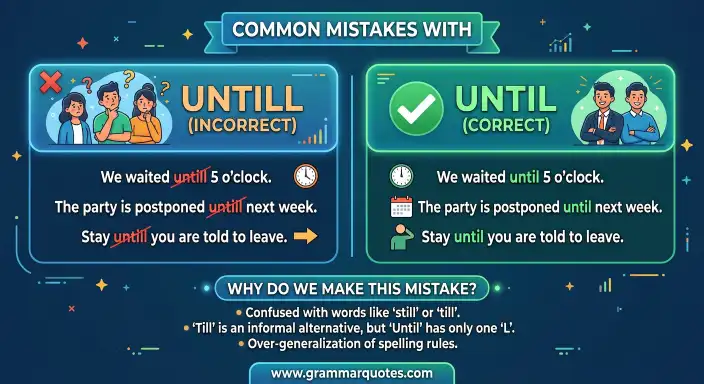
Understanding common errors will help you use until correctly in your writing.
Mistake 1: Adding an Extra L
Incorrect: I will stay here untill Monday.
Correct: I will stay here until Monday.
Explanation: The correct spelling ends with one L.
Memory tip: Think of until = unti + l. The final letter appears only once.
Mistake 2: Using Until Instead of By
Incorrect: Please send me the file until Friday.
Correct: Please send me the file by Friday.
Explanation: If you mean that Friday is the final deadline, use by. In many contexts, until describes how long a state or action continues.
Mistake 3: Using the Wrong Verb Form
Incorrect: Wait until he will arrive.
Correct: Wait until he arrives.
Explanation: In a time clause referring to the future, English normally uses the present simple rather than will.
More examples:
- Incorrect: I will call you until I will reach home.
- Correct: I will call you when I reach home.
The best choice depends on if you mean that an action continues up to a point or happens at a particular time.
Mistake 4: Confusing Until and Till
Incorrect: Till is always wrong in formal English.
Correct: Till is a valid English word with the same basic meaning as until.
Explanation: Till is not simply a spelling mistake. It is an established word, though until may suit some formal contexts better.
Mistake 5: Using Until When You Mean Before
Incorrect: Finish the task until the meeting starts.
Better: Finish the task before the meeting starts.
Explanation: Before means earlier than an event. Until describes the endpoint of an ongoing action or situation.
Mistake 6: Treating Untill as a Different Word
Incorrect: Untill is the informal version of until.
Correct: Untill is a misspelling, not a standard informal alternative.
Explanation: Informal writing does not make the extra L correct. Use until in texts, posts, and professional messages.
Everyday Examples of Until
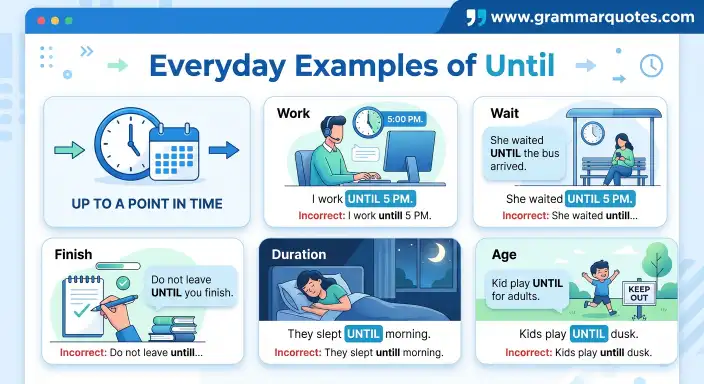
The following examples show how to use until naturally in different situations.
1. Emails
- I will be unavailable until Monday.
- Please wait until you receive the confirmation email.
- The application portal will remain open until November 30.
These examples are useful for professional communication because they clearly state a time limit.
2. Business Writing
- The promotional price is valid until the end of the month.
- The office will remain closed until further notice.
- Please keep all records until the audit is complete.
Use until when you want to explain how long a policy, offer, or arrangement remains in effect.
3. News Headlines
- Local Schools Remain Closed Until Monday
- New Rules Will Apply Until Further Notice
- Road Repairs Continue Until the Weekend
These headline examples show how until can express the endpoint of a closure, rule, or activity.
4. Blogs
- Keep reading until you reach the final section.
- Do not publish your post until you check the facts.
- Practise these spelling rules until you remember them.
These sentences work well in guides, tutorials, and educational content.
5. Social Media
- Waiting until the weekend!
- I cannot relax until the results arrive.
- Keep going until you reach your goal.
In informal posts, until and till can both work. However, untill remains incorrect.
6. Academic Writing
- The samples were stored until testing began.
- Students may revise their answers until the examination ends.
- The study continued until the required data had been collected.
Academic writing benefits from accurate spelling and clear descriptions of time.
7. Daily Conversation
- Wait until I get back.
- I slept until ten in the morning.
- We talked until midnight.
- You cannot leave until the teacher arrives.
These short sentences demonstrate how naturally until fits into everyday speech.
Google Trends and Modern Usage
People often search for untill or until because they want to confirm the correct spelling before submitting an assignment, publishing an article, sending an email, or posting online.
The confusion is easy to understand. English contains many words with double consonants, and until may look as though it should follow the same pattern.
Which Spelling Is More Popular?
In standard modern English, until is the accepted spelling. The form untill is generally a spelling error.
This conclusion comes from standard dictionary usage and established English spelling conventions. It should not be confused with a measured Google Trends comparison.
Without a verified Trends dataset, it would be misleading to claim exact search volumes or percentages for either spelling.
Why Does This Keyword Attract Searches?
Common reasons include:
- Students checking spelling before exams.
- Writers proofreading articles and assignments.
- English learners studying common spelling mistakes.
- Employees checking professional emails.
- Bloggers researching grammar keywords.
- People using spelling suggestions in search engines and writing tools.
How Can You Check Modern Usage?
You can compare the two spellings using Google Trends or consult established dictionaries.
Useful references include:
These resources can help confirm the standard spelling and explain how the word is used.
Quick Comparison Table
| Version | Meaning | Correct? | Region | Example |
| Until | Up to a time or event | Yes | Worldwide | Wait until Monday. |
| Untill | No standard meaning as an alternative spelling | No | None as a standard variant | Avoid this spelling. |
| Till | Up to a time or event | Yes | Worldwide | Wait till Monday. |
| ‘Til | Informal shortened form | Informal | Varies | See you ’til then. |
| By | No later than a deadline | Yes, when appropriate | Worldwide | Submit it by Monday. |
| Before | Earlier than a time or event | Yes, when appropriate | Worldwide | Finish before Monday. |
The most important difference is that until and till are valid words, while untill is not the standard spelling. The words by and before have related but different meanings.
Key Takeaways
- Until is the correct spelling in standard English.
- Untill is a spelling mistake and should be avoided.
- The word until means up to a particular time, event, or point.
- British, American, Canadian, and Australian English all use until.
- Till is also correct and has the same basic meaning.
- Use by when referring to a deadline that must not be missed.
- Use before when an action must happen earlier than an event.
- Remember that until ends with one L.
Frequently Asked Questions
1. Is it untill or until?
Until is correct. It is the standard spelling in modern English and means up to a certain time, event, or point. Untill is a common spelling error caused by adding an unnecessary second L. Use until in schoolwork, professional emails, business documents, blogs, and everyday messages.
2. Why is untill incorrect?
Untill is incorrect because it is not the standard spelling of the English word. The accepted form is until, with one L at the end. Although people may type the extra letter by mistake, that does not make it a valid alternative. Spell checking tools can help identify this error.
3. Is until correct in British English?
Yes. British English uses until, just like American, Canadian, and Australian English. There is no regional spelling difference for this word. British writers may also use till, which is a valid alternative in many contexts. For formal documents, until is a reliable choice.
4. Is till the same as until?
Yes. Till and until generally have the same meaning. Both describe an action or situation that continues up to a particular time or event. For example, “Wait until noon” and “Wait till noon” are both correct. Choose the form that best matches your tone and the style of your writing.
5. Does until have one L or two?
Until has one L at the end. Its final letters are i l, not i l l. A simple way to remember this is to write the word several times correctly: until, until, until. This can help you avoid adding an extra letter when typing quickly.
6. Can I use until in formal writing?
Yes. Until is suitable for formal and informal writing. You can use it in essays, academic papers, professional emails, reports, contracts, and business announcements. It clearly shows when an action, arrangement, or situation ends. Always check the sentence to make sure until expresses the intended meaning.
7. What is the difference between until and by?
Until describes how long an action or situation continues. By usually sets a deadline, meaning something must happen no later than a particular time. For example, “I will work until five” describes the length of the work period. “I will finish by five” means the work will be completed before or at five.
8. What is the difference between until and before?
Until usually describes a continuing state or action that reaches a time or event. Before means earlier than a time or event. For example, “I waited until noon” describes a period of waiting. “I arrived before noon” means the arrival happened earlier than noon.
9. Is until one word or two?
Until is one word. It should not be written as two separate words. Use it as a single word in phrases such as until tomorrow, until next week, and until further notice. The same spelling applies across standard varieties of English.
10. How can I remember the correct spelling of until?
Remember this simple rule: Until has one L at the end. You can also connect it with familiar phrases such as “until tomorrow” or “until next time.” Reading and writing these phrases regularly can help the correct spelling become automatic.
Conclusion
When choosing between untill or until, the answer is clear: until is the correct spelling. It is used in British, American, Canadian, Australian, and international English. The spelling does not change according to region, and the extra L in untill is unnecessary.
Use until to describe how long an action or situation continues. For example, you can wait until Monday, study until midnight, or keep a service available until further notice. Remember that till is also correct, while by and before express different meanings and should be chosen according to the sentence.
If you write essays, emails, blog posts, or business documents, checking small spelling details can make your writing clearer and more professional. A simple proofreading habit can help you catch this error before you publish or send your work.
The easiest rule to remember is this: write until with one L, and never use untill as the standard spelling. If you found this guide helpful, explore more spelling and grammar comparisons to strengthen your everyday English.
Discover More Articles!
Business or Buisness: Which Spelling Is Correct?(2026)
Britain or England: What Is the Difference? Meaning, Geography, and Key Facts
Gibberish or Jibberish: Which Spelling Is Correct?(2026)

Ethan Parker is an English-language writer known for his interest in words, language, and clear communication. His work focuses on making everyday English easier to understand through simple explanations and practical examples.