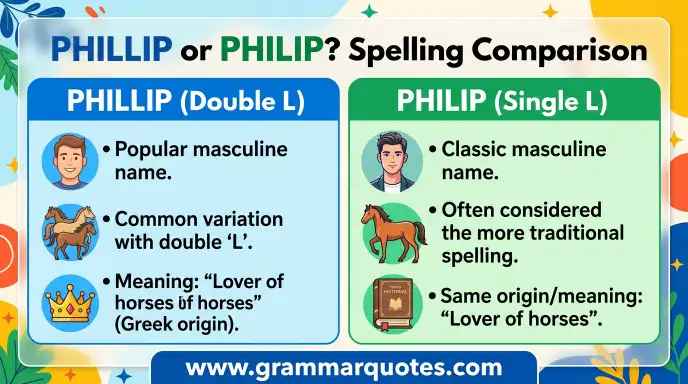
Philip is the standard and most widely accepted spelling of the masculine given name, while Phillip is also a correct and established spelling variant. Both names are used in English speaking countries, and neither is inherently incorrect. The main difference is their spelling: Philip has one l, while Phillip has two.
For example, “Philip is my classmate” and “Phillip is my classmate” are both grammatically correct when written according to the person’s actual name. However, personal names should always be spelled the way their owners use them. If someone is named Phillip, changing the spelling to Philip would be incorrect for that individual.
The name Philip comes from the Greek name Philippos, traditionally interpreted as “lover of horses” or “friend of horses.” It has a long history in English and many other languages. Phillip developed as an alternative spelling and is also widely used as a personal name.
In this guide, you will learn the difference between Philip and Phillip, their meanings, origins, pronunciation, common mistakes, and examples to help you understand when to use each spelling.
Quick Answer: Phillip vs Philip
| Feature | Philip | Phillip |
| Spelling | One l | Two ls |
| Is it correct? | Yes | Yes |
| Type | Masculine given name | Masculine given name |
| Meaning | Traditionally “lover of horses” | Traditionally associated with the same name meaning |
| Usage | Long established, widely used spelling | Established alternative spelling |
| Example | Philip joined the meeting. | Phillip joined the meeting. |
Quick rule: Both Philip and Phillip are correct personal names. Use the spelling that belongs to the person you are referring to.
What Does Philip Mean?
Philip is a masculine given name with Greek origins. It comes from the ancient Greek name Philippos, which combines elements associated with horses and affection or friendship.
Definition and Meaning of Philip
The name Philip is traditionally interpreted as “lover of horses” or “friend of horses.” It has been used for centuries and appears in historical, religious, and royal contexts.
Examples:
- Philip is studying computer science.
- My friend Philip lives in London.
- Philip introduced himself to the new students.
- The book was written by Philip.
In each example, Philip is a person’s name, so it begins with a capital letter.
Historical Use of Philip
Philip has a long history in European naming traditions. It was used in ancient Greece and later became popular in many European languages. Several historical rulers and religious figures also bore this name.
Because of its long history, Philip is a familiar spelling in books, historical records, and formal writing.
What Does Phillip Mean?
Phillip is an alternative spelling of the same masculine given name. It is not simply a spelling mistake; many people use it as their official first name.
Definition and Meaning of Phillip
Phillip is generally associated with the same Greek name and traditional meaning as Philip: “lover of horses” or “friend of horses.”
Examples:
- Phillip is my neighbour.
- Phillip works at a local school.
- We invited Phillip to the event.
- Phillip sent an email yesterday.
These sentences are correct when the person’s name is spelled Phillip.
Why Does Phillip Have Two Ls?
The spelling Phillip contains an extra l compared with Philip. Both forms developed and became established as personal names.
English contains many personal names with alternative spellings. Sometimes the differences reflect family traditions, historical usage, or personal preference rather than a change in meaning.
For this reason, there is no universal rule requiring everyone to use Philip instead of Phillip.
Phillip vs Philip: Main Differences
The main difference between Philip and Phillip is their spelling, not their basic meaning or grammatical function.
| Feature | Philip | Phillip |
| Number of Ls | One | Two |
| Pronunciation | Usually the same | Usually the same |
| Meaning | Traditionally “lover of horses” | Traditionally “lover of horses” |
| Grammatical category | Proper noun | Proper noun |
| Usage | Common established spelling | Common alternative spelling |
| Correct in formal writing? | Yes | Yes, when it is the person’s name |
Both spellings can be used in formal and informal writing. The correct choice depends on the individual being named.
British vs American English: Phillip or Philip?
Philip and Phillip are used in both British and American English. The difference is not a standard British versus American spelling rule.
| English variety | Philip | Phillip |
| British English | Correct | Correct |
| American English | Correct | Correct |
| Canadian English | Correct | Correct |
| Australian English | Correct | Correct |
A person’s nationality does not determine which spelling their name must use. For example, a British person can be named Phillip, and an American person can be named Philip.
Remember: Personal names follow individual and family preferences, not the same spelling rules that govern many ordinary English words.
Pronunciation: Are Philip and Phillip Pronounced Differently?
In most English speaking contexts, Philip and Phillip are pronounced the same way.
Both are commonly pronounced FIL ip, with the stress on the first syllable.
- Philip: FIL ip
- Phillip: FIL ip
The extra l in Phillip does not normally create an additional sound. However, individual pronunciation can vary, so it is best to follow how the person says their own name.
Common Mistakes When Using Philip or Phillip
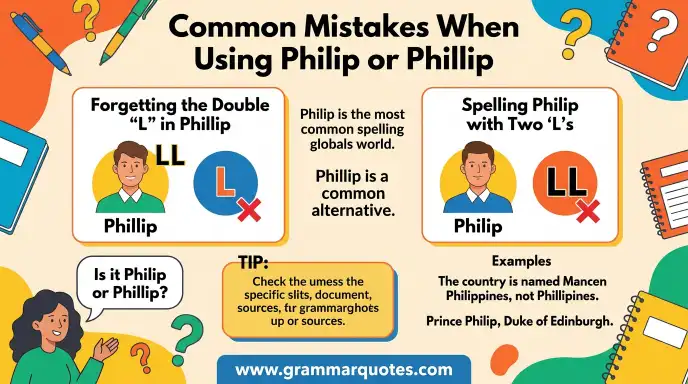
Although both spellings are correct, writers sometimes use the wrong version when referring to a specific person.
Mistake 1: Assuming Phillip Is Always Incorrect
Incorrect claim: Phillip is always a misspelling of Philip.
Correct understanding: Phillip is an established personal name spelling.
Why? Both forms are used as given names. The correct spelling depends on the person’s actual name.
Mistake 2: Changing Someone’s Name to the More Familiar Spelling
Incorrect: Phillip Smith is written as Philip Smith without checking his name.
Correct: Write Phillip Smith if that is his official spelling.
Why? Personal names should be reproduced accurately, even when another spelling is more familiar.
Mistake 3: Assuming the Two Spellings Have Different Meanings
Incorrect claim: Philip means one thing, but Phillip means something completely different.
Correct understanding: Both spellings are generally associated with the same Greek name and traditional meaning.
Why? The extra l usually represents a spelling variation rather than a difference in meaning.
Mistake 4: Using a Lowercase Letter for a Name
Incorrect: phillip joined the class.
Correct: Phillip joined the class.
Why? Names are proper nouns and should begin with a capital letter in English.
Mistake 5: Using One Spelling Consistently for Everyone
Incorrect assumption: Everyone named Philip or Phillip should use the same spelling.
Correct understanding: Check the spelling for each individual.
Why? Names are personal identifiers, and their spelling can differ from person to person.
Everyday Examples of Philip and Phillip

The following examples demonstrate how both spellings can be used in sentences.
Examples Using Philip
- Philip is my best friend.
- I met Philip at school yesterday.
- Philip enjoys reading history books.
- Our teacher asked Philip to answer the question.
- Philip sent me a message last night.
- The invitation was addressed to Philip.
- Philip wants to become a software engineer.
- We travelled with Philip during the holidays.
- Philip completed his assignment on time.
- Everyone welcomed Philip to the team.
Examples Using Phillip
- Phillip is joining us for dinner.
- I spoke to Phillip after class.
- Phillip works in a nearby office.
- The letter was written by Phillip.
- Phillip enjoys learning new languages.
- We invited Phillip to the celebration.
- Phillip helped his friend with the project.
- The teacher called Phillip to the front.
- Phillip has already submitted his application.
- I saved Phillip’s number in my phone.
All these sentences are grammatically correct when the spelling matches the person’s name.
Word Origin and History of Philip
The name Philip comes from the ancient Greek Philippos. It is commonly explained through two Greek elements: philos, associated with love or friendship, and hippos, meaning horse. This gives the traditional interpretation “lover of horses” or “friend of horses.”
The name became established in the ancient Greek world and later spread through European languages. It has been used by historical figures, monarchs, and people in many countries.
Phillip is an established alternative spelling of the same given name. The extra l distinguishes its written form but does not usually change its pronunciation or traditional meaning.
Today, both names remain in use. Their popularity can vary by country, generation, and family tradition.
Grammar Rules for Phillip and Philip
Because Philip and Phillip are proper nouns, they follow the basic rules for personal names.
1. Capitalize the First Letter
Names begin with a capital letter.
- Correct: Philip is here.
- Correct: Phillip is here.
- Incorrect: phillip is here.
2. Use the Correct Spelling for the Individual
If a person’s name is Phillip, do not change it to Philip simply because the latter spelling is more familiar.
- Correct: Phillip Brown attended the meeting.
- Correct: Philip Brown attended the meeting, if that is his actual name.
3. Form the Possessive Correctly
To show that something belongs to a person, add an apostrophe and s.
- Philip’s book is on the desk.
- Phillip’s phone is ringing.
- I read Philip’s email.
- We visited Phillip’s house.
The apostrophe goes after the complete name.
4. Form the Plural When Referring to More Than One Person With the Same Name
If you are talking about multiple people who share a name, add s.
- The two Philips attended the event.
- The two Phillips attended the event.
In these examples, the first sentence refers to two people named Philip, while the second refers to two people named Phillip. The family or individual spelling determines which form is appropriate.
Related Names and Variations
Philip and Phillip are part of a wider family of names used in different languages.
| Name | Language or context | Note |
| Philip | English | Established spelling |
| Phillip | English | Alternative spelling |
| Philippe | French | French form |
| Felipe | Spanish | Spanish form |
| Filip | Several European languages | Variant used in multiple countries |
| Filippo | Italian | Italian form |
These names are related through the same historical name tradition, although pronunciation and spelling vary by language.
Key Takeaways
- Philip and Phillip are both correct personal names.
- Philip has one l, while Phillip has two.
- Both spellings are traditionally associated with the meaning “lover of horses” or “friend of horses.”
- The names are usually pronounced the same way.
- Neither spelling is exclusively British or American.
- Always use the spelling that belongs to the person you are referring to.
- Capitalize both names because they are proper nouns.
People Also Ask
Is Phillip or Philip Correct?
Both are correct spellings of a masculine given name. Use Philip or Phillip according to the individual’s actual name.
What Is the Difference Between Philip and Phillip?
The difference is the number of ls. Philip has one, while Phillip has two. Both are associated with the same traditional name meaning.
Is Phillip a Misspelling of Philip?
No. Phillip is an established alternative spelling of the name Philip. It is correct when that is the person’s chosen or official spelling.
Are Philip and Phillip Pronounced the Same?
Usually, yes. Both are commonly pronounced “FIL ip,” although individuals may have their own pronunciation preferences.
Is Philip British or American?
Philip is used in both British and American English. Phillip is also used in both. Neither spelling belongs exclusively to one variety of English.
What Does the Name Philip Mean?
Philip comes from the Greek name Philippos and is traditionally interpreted as “lover of horses” or “friend of horses.” Phillip is generally associated with the same meaning.
Frequently Asked Questions (FAQs)
1. Which spelling is more common: Philip or Phillip?
Philip is a long established and widely used spelling. Phillip is also well established. Relative popularity varies by country and generation.
2. Can Phillip be used in official documents?
Yes. If Phillip is the person’s legal name, that spelling should be used in official documents and correspondence.
3. Does the extra L change the meaning?
Generally, no. The two spellings are variants of the same given name and share the same traditional meaning.
4. How do I write the possessive form of Philip?
Write Philip’s, as in “Philip’s notebook is missing.” For someone named Phillip, write Phillip’s.
5. Should I correct Phillip to Philip in my writing?
Only if you know that the intended spelling is Philip. If the person’s name is Phillip, keep the spelling unchanged.
6. Can both spellings appear in the same document?
Yes, if they refer to different people. For example, Philip and Phillip may both appear in a class list if two students have those respective names.
Conclusion
Choosing between Philip and Phillip is straightforward once you understand that both are established spellings of the same given name. Philip uses one l, while Phillip uses two. Both are traditionally associated with the Greek name Philippos and the meaning “lover of horses” or “friend of horses.”
Unlike many English spelling comparisons, this is not a case where one form is correct and the other is always wrong. Both spellings are used in British, American, and other varieties of English. They are also usually pronounced the same way.
The most important rule is to spell a person’s name exactly as that person uses it. If someone is named Philip, write Philip. If their name is Phillip, write Phillip. Paying attention to this small detail makes your writing more accurate, respectful, and professional.
Discover More Articles!
Overlaid or Overlayed: Which Spelling Is Correct? Meaning, Rules, and Examples
Enrol vs Enroll: Meaning, Spelling Differences, and Mistakes
Coaches or Coach’s: Meaning, Differences, Grammar Rules, and Examples

Ethan Parker is an English-language writer known for his interest in words, language, and clear communication. His work focuses on making everyday English easier to understand through simple explanations and practical examples.