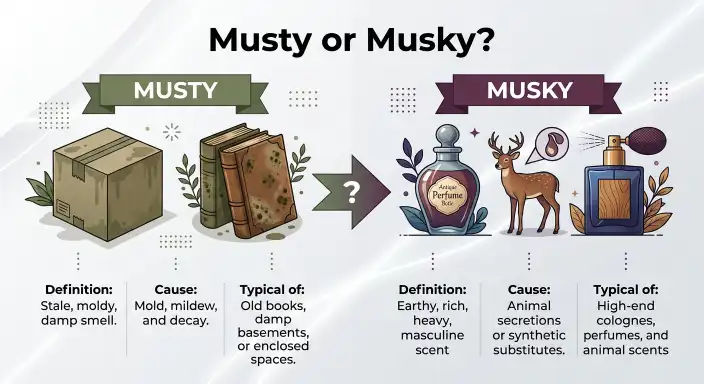
Musty and musky are both correct English words, but they describe different types of smells. Musty usually refers to a stale, damp, or mouldy smell, often found in old rooms, basements, or clothes that have been stored for a long time. Musky, on the other hand, describes a strong, warm, earthy, or sweet scent associated with musk, perfumes, and certain natural fragrances.
For example, “The basement smells musty” suggests that the space is damp or poorly ventilated. In contrast, “The perfume has a musky scent” describes a warm, deep fragrance that may be used in perfumes and scented products.
Although these words look and sound similar, they are not interchangeable. Using the wrong word can change the meaning of a sentence, especially when describing rooms, clothing, perfumes, or other scents.
In this guide, you will learn the meanings of musty and musky, their main differences, common mistakes, pronunciation, and practical examples to help you use both words correctly.
Quick Answer: Musty vs Musky
| Feature | Musty | Musky |
| Meaning | Stale, damp, or mould like smell | Warm, earthy, or musk like fragrance |
| Common use | Old rooms, damp clothes, stored items | Perfumes, fragrances, scented products |
| Typical impression | Stale or unpleasant | Warm, rich, sometimes sweet |
| Example | The cupboard smells musty. | The perfume smells musky. |
| Related word | Mustiness | Musk |
Quick rule: Use musty for a stale or damp smell and musky for a warm, earthy fragrance associated with musk.
What Does Musty Mean?
Musty is an adjective used to describe a stale, damp, or mould like smell. It often refers to places or objects that have been stored for a long time or exposed to moisture with little ventilation.
Definition and Meaning of Musty
The word musty commonly describes an unpleasant smell associated with dampness, old materials, or poor air circulation.
Examples:
- The old house has a musty smell.
- My clothes smelled musty after being left in a damp cupboard.
- The basement feels cold and musty.
- These old books have a musty odour.
In each example, the smell suggests that the object or space may be damp, stale, or insufficiently ventilated.
When Should You Use Musty?
Use musty when describing:
- Old or poorly ventilated rooms
- Damp basements and cupboards
- Clothes stored while damp
- Books and furniture kept in humid places
- Air that smells stale or mould like
For example, “The bedroom smelled musty after remaining closed for several weeks” suggests that the room needs fresh air or that a dampness problem may be present.
Important: A musty smell can sometimes indicate excess moisture or mould, but the smell alone cannot confirm the cause.
What Does Musky Mean?
Musky is an adjective used to describe a smell that resembles musk. Depending on the context, it may be warm, earthy, rich, slightly sweet, or deep.
The word is especially common in descriptions of perfumes, fragrances, soaps, candles, and scented products.
Definition and Meaning of Musky
A musky scent often has a warm, deep, or earthy character. In modern perfumery, musk notes may be produced using synthetic fragrance ingredients rather than animal derived materials.
Examples:
- Her perfume has a soft, musky fragrance.
- The candle gives off a warm, musky scent.
- The fragrance combines musky and woody notes.
- He prefers perfumes with a subtle musky smell.
These examples describe a particular fragrance rather than a stale or damp smell.
When Should You Use Musky?
Use musky when describing:
- Perfumes and colognes
- Fragranced candles and soaps
- Warm, earthy scents
- Fragrance combinations with woody or floral notes
- A smell resembling musk
For example, “The perfume has a musky base with hints of vanilla” describes the character of the fragrance.
Musky scents can be pleasant, strong, subtle, sweet, or earthy depending on the ingredients and the person’s perception.
Musty vs Musky: Main Differences
The main difference between musty and musky is the type of smell each word describes.
| Feature | Musty | Musky |
| Part of speech | Adjective | Adjective |
| Main association | Dampness and stale air | Musk and warm fragrance |
| Typical context | Buildings, clothes, books | Perfumes, candles, scented products |
| Common impression | Often unpleasant | Often intentional as a fragrance |
| Example | A musty room | A musky perfume |
Although both words describe smells, their meanings are different. A musty room may need cleaning or improved ventilation, while a musky perfume may be designed to smell that way.
Musty vs Musky: Pronunciation
Musty and musky are pronounced similarly, which can make them confusing for English learners.
- Musty: MUS tee
- Musky: MUS kee
The main difference is the final consonant sound: musty ends with a t sound before the final syllable, while musky has a k sound.
Practising the words aloud can help you distinguish them in conversation.
Common Mistakes When Using Musky or Musty
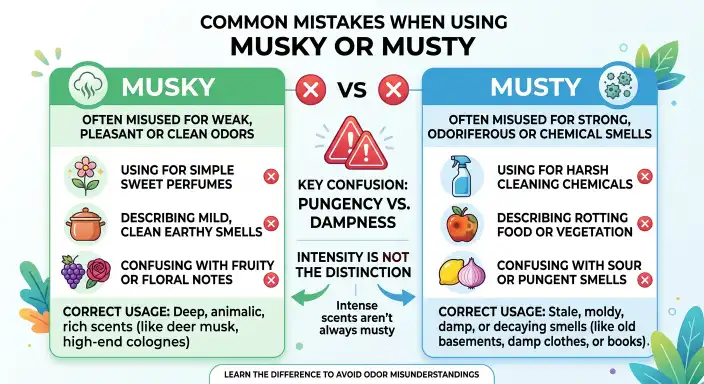
Because the words look and sound similar, writers sometimes use one when they mean the other.
Mistake 1: Describing a Damp Room as Musky
Incorrect: The basement has a musky smell because it is damp.
Better: The basement has a musty smell because it is damp.
Why? Musty is the more suitable word for a stale or damp smell.
Mistake 2: Describing Perfume as Musty When You Mean Musk
Incorrect: This perfume has a musty fragrance.
Better: This perfume has a musky fragrance.
Why? Musky describes a fragrance associated with musk. Musty usually suggests a stale or mould like odour.
Mistake 3: Assuming Musky Always Means Pleasant
Incorrect assumption: Every musky smell is pleasant.
Correct understanding: A musky scent can be appealing to some people and too strong or unpleasant to others.
Why? Smell preferences are subjective, and fragrance descriptions depend on personal perception.
Mistake 4: Assuming Every Musty Smell Confirms Mould
Incorrect assumption: If a room smells musty, it definitely contains visible mould.
Correct understanding: A musty smell can be associated with moisture or mould, but the smell alone does not prove the exact cause.
Why? Stale air, damp materials, and other environmental conditions may contribute to unpleasant odours.
Mistake 5: Treating Musty and Musky as Synonyms
Incorrect: Musty and musky have exactly the same meaning.
Correct understanding: Musty describes a stale or damp smell, while musky describes a musk like fragrance.
Why? Their meanings and typical contexts are different.
Everyday Examples of Musty and Musky
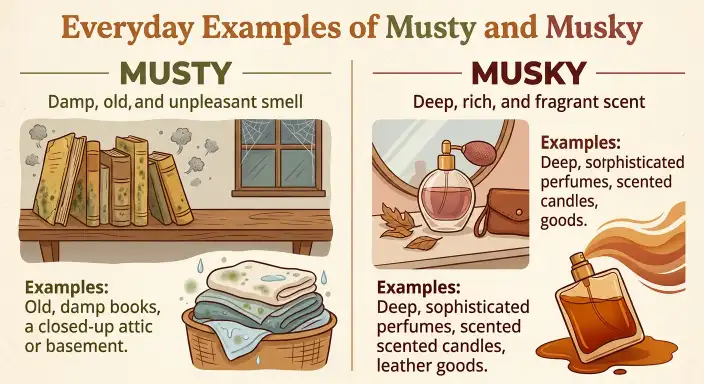
These examples show how to use both words naturally.
Examples Using Musty
- The old cupboard smells musty.
- The basement had a musty odour.
- My jacket smelled musty after being stored for months.
- The library contained several musty old books.
- The closed room felt damp and musty.
- The towels developed a musty smell after remaining wet.
- We opened the windows to clear the musty air.
- The wooden box had a musty smell.
- The unused guest room smelled musty.
- The curtains had a stale, musty odour.
Examples Using Musky
- Her perfume has a soft, musky scent.
- The candle releases a warm, musky fragrance.
- I prefer musky perfumes with woody notes.
- The fragrance has a musky base.
- The soap has a light, musky aroma.
- The perfume combines floral and musky notes.
- He chose a fragrance with a rich, musky character.
- The scented oil has an earthy, musky smell.
- This cologne has a warm and musky finish.
- The fragrance becomes softer and more musky as it settles.
Word Origin and History of Musty and Musky
The words musty and musky developed from different word histories, even though their spellings are similar.
Origin of Musty
Musty is associated with the idea of stale or mould like odours. It developed in English to describe smells linked with dampness, age, and a lack of fresh air.
Over time, the word became common in descriptions of old buildings, stored clothing, books, furniture, and enclosed spaces.
Origin of Musky
Musky comes from musk, a word historically associated with a strong smelling substance used in perfumery. The word musk entered English through earlier European language forms and ultimately has roots in older trade and language traditions.
Today, musky is widely used in the fragrance industry to describe a particular scent profile. Modern perfumes often use synthetic musk ingredients.
Word Formation and Grammar Rules
Both musty and musky are adjectives. They describe nouns by explaining what something smells like.
How to Use Musty in a Sentence
Use musty before a noun or after a linking verb.
- Before a noun: The musty room needs fresh air.
- After a linking verb: The room smells musty.
- With an adverb: The cupboard smells extremely musty.
How to Use Musky in a Sentence
Use musky in the same grammatical positions.
- Before a noun: She wore a musky perfume.
- After a linking verb: The fragrance smells musky.
- With an adverb: The candle has a distinctly musky scent.
Related Forms
| Word | Part of speech | Meaning |
| Musty | Adjective | Stale or damp smelling |
| Mustiness | Noun | The quality of smelling musty |
| Musky | Adjective | Having a musk like scent |
| Musk | Noun | A substance or fragrance note associated with musk |
Examples:
- The mustiness of the room was noticeable.
- The perfume contains a musk note.
- The old fabric smelled musty.
- The fragrance was warm and musky.
Synonyms and Related Words for Musty and Musky
The best synonym depends on the type of smell you want to describe.
Synonyms for Musty
| Word | Meaning | Example |
| Stale | Not fresh | The room had stale air. |
| Mouldy | Affected by mould or smelling of it | The damp box smelled mouldy. |
| Fusty | Old, stuffy, or stale smelling | The closed office felt fusty. |
| Damp | Slightly wet | The towels felt damp. |
| Stuffy | Having little fresh air | The room was stuffy. |
These words are related but not identical. For example, damp describes moisture, while musty describes a particular stale smell.
Synonyms and Related Words for Musky
| Word | Meaning | Example |
| Earthy | Resembling soil or natural materials | The perfume has an earthy note. |
| Woody | Resembling wood or tree bark | The fragrance has a woody base. |
| Warm | Rich or soft in scent character | The candle has a warm aroma. |
| Pungent | Strong and noticeable | The scent was pungent. |
| Rich | Deep or full in character | The perfume has a rich fragrance. |
These words may describe some aspects of a musky fragrance, but they are not exact synonyms in every context.
Key Takeaways
- Musty describes a stale, damp, or mould like smell.
- Musky describes a warm, earthy, or musk like fragrance.
- Musty is commonly used for old rooms, damp clothes, and stored objects.
- Musky is often used for perfumes, candles, soaps, and scented products.
- Both words are adjectives.
- Musty and musky are not interchangeable.
- A musty smell may suggest moisture problems, but it does not by itself confirm mould.
People Also Ask
Is It Musty or Musky?
Both words are correct, but they have different meanings. Use musty for stale or damp smells and musky for warm, earthy, musk like fragrances.
What Does Musty Smell Mean?
A musty smell is usually stale, damp, or mould like. It is often associated with enclosed spaces, old materials, or areas with excess moisture.
What Does Musky Smell Mean?
A musky smell is a fragrance associated with musk. It may be warm, earthy, rich, or slightly sweet, depending on the ingredients.
Is Musky a Good Smell?
A musky scent can be pleasant to many people, especially in perfumes, but preferences vary. Some musky fragrances may smell too strong to certain people.
Can a Room Smell Musty Without Mould?
Yes. A musty smell can be associated with stale air, damp materials, or other environmental conditions. It can indicate a moisture problem, but the smell alone cannot confirm the presence of mould.
What Is the Difference Between Musty and Mouldy?
Musty describes a stale or damp smell, while mouldy more directly suggests mould or something affected by it. The terms overlap, but they are not identical.
Frequently Asked Questions (FAQs)
1. Is musty a positive or negative word?
Musty usually has a negative meaning because it suggests stale air, dampness, or an unpleasant smell.
2. Is musky the same as earthy?
No. Musky refers to a musk like scent, while earthy describes a smell resembling soil, plants, or natural materials. A fragrance can be both musky and earthy.
3. Can clothes smell musty?
Yes. Clothes may develop a musty smell when stored while damp or kept in an enclosed space with poor ventilation.
4. Is musky used only for perfume?
No. Although musky is especially common in perfume descriptions, it can also describe other scents that resemble musk.
5. What is the noun form of musty?
The noun form is mustiness, which refers to the quality or condition of smelling musty.
6. How can I remember the difference between musty and musky?
Remember this simple association: musty = stale or damp; musky = fragrance or musk. Think of an old, closed cupboard for musty and a bottle of perfume for musky.
Conclusion
Understanding the difference between musty and musky helps you describe smells accurately. Although the words look and sound similar, they communicate different ideas. Musty usually refers to a stale, damp, or mould like odour commonly associated with old rooms, stored clothes, and enclosed spaces. Musky describes a fragrance associated with musk, often characterised as warm, earthy, rich, or slightly sweet.
The easiest way to remember the distinction is to connect musty with stale air and musky with perfume. If you are describing a room that has been closed for months, musty is usually the appropriate word. If you are describing a fragrance with a deep, warm scent, musky is likely the better choice.
Both words are useful in everyday conversation, creative writing, product descriptions, and fragrance reviews. By learning their meanings and practising the examples, you can choose the right word and make your English more precise and natural.
Discover More Articles!
Overlaid or Overlayed: Which Spelling Is Correct? Meaning, Rules, and Examples
Enrol vs Enroll: Meaning, Spelling Differences, and Mistakes
Coaches or Coach’s: Meaning, Differences, Grammar Rules, and Examples

Ethan Parker is an English-language writer known for his interest in words, language, and clear communication. His work focuses on making everyday English easier to understand through simple explanations and practical examples.