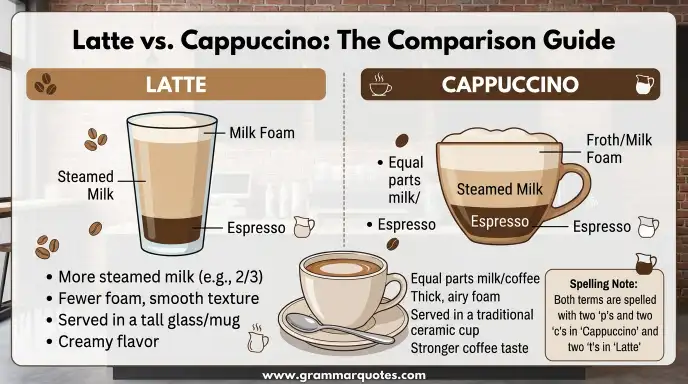
Latte and cappuccino are both espresso based coffee drinks, but they differ in their milk to coffee ratio, foam texture, and overall taste. A latte usually contains more steamed milk and a thin layer of foam, while a cappuccino typically has a more balanced combination of espresso, steamed milk, and milk foam.
For example, you might order a latte if you prefer a smooth, creamy coffee with a mild espresso flavour. You might choose a cappuccino if you enjoy a stronger coffee taste and a thicker, foamy texture.
Both drinks are popular choices at coffee shops, and neither is universally better than the other. Your ideal choice depends on how strong, creamy, or foamy you like your coffee.
In this guide, you will learn the difference between latte and cappuccino, their meanings, ingredients, examples, preparation methods, common mistakes, and answers to frequently asked questions.
Quick Answer: Latte or Cappuccino?
A latte is generally milkier and creamier, while a cappuccino usually has a thicker layer of foam and a more pronounced espresso flavour.
- Latte: Espresso mixed with a relatively large amount of steamed milk and a thin layer of milk foam.
- Cappuccino: Espresso combined with steamed milk and a substantial layer of milk foam, traditionally in roughly balanced proportions.
Correct Examples
- Correct: I ordered a latte because I wanted a creamy coffee.
- Correct: She chose a cappuccino because she likes thick milk foam.
- Correct: A latte usually contains more steamed milk than a similarly sized cappuccino.
- Correct: Both latte and cappuccino are made with espresso.
Remember: Choose a latte for a smoother, milkier drink or a cappuccino for a foamier coffee with a more noticeable espresso flavour.
What Is a Latte?
A latte, short for the Italian caffè latte, is a coffee drink made with espresso and steamed milk, usually finished with a thin layer of milk foam.
The extra milk gives a latte a smooth, creamy texture and often makes the espresso taste milder than it does in a smaller cappuccino.
Lattes are frequently served in larger cups and may feature decorative patterns made by pouring steamed milk into espresso. This technique is known as latte art.
Examples of Latte in Sentences
- I ordered a latte with warm milk at the café.
- She enjoys drinking a latte while reading a book.
- The barista created a heart shaped pattern on my latte.
- He prefers a vanilla latte to plain espresso.
- We stopped at a coffee shop and ordered two lattes.
What Is a Latte Made Of?
A traditional latte contains:
- Espresso: The concentrated coffee base.
- Steamed milk: Provides the drink’s creamy texture.
- Milk foam: Adds a light layer on top.
The exact proportions depend on the café, cup size, and recipe.
What Does a Latte Taste Like?
A latte generally tastes smooth, creamy, and milky, with espresso flavour in the background. The steamed milk softens the coffee’s bitterness and intensity.
For example, someone who finds plain espresso too strong may prefer a latte because the milk creates a gentler overall flavour.
When Should You Choose a Latte?
Choose a latte if you prefer:
- A creamy coffee texture.
- A relatively mild espresso flavour.
- More steamed milk in your drink.
- Flavoured coffee options, such as vanilla or caramel lattes.
- A drink that works well with latte art.
What Is a Cappuccino?
A cappuccino is an espresso based coffee drink traditionally prepared with espresso, steamed milk, and a generous layer of milk foam.
It is commonly served in a smaller cup than a latte, although serving sizes vary between coffee shops. Its foam creates a lighter, airier texture, while the espresso remains prominent.
Examples of Cappuccino in Sentences
- I ordered a cappuccino with extra milk foam.
- He enjoys a cappuccino after breakfast.
- The café served my cappuccino in a small ceramic cup.
- She sprinkled a little cocoa powder over her cappuccino.
- The barista prepared two cappuccinos for our table.
What Is a Cappuccino Made Of?
A traditional cappuccino contains three main components:
- Espresso: Provides the concentrated coffee flavour.
- Steamed milk: Adds creaminess and balances the espresso.
- Milk foam: Creates the characteristic thick, airy top layer.
Traditional recipes often aim for roughly equal proportions of espresso, steamed milk, and foam, although modern café recipes vary.
What Does a Cappuccino Taste Like?
A cappuccino generally has a more noticeable espresso flavour than a latte of a similar size. Its foam creates a light, airy mouthfeel, while the milk softens the coffee’s intensity.
For example, if you enjoy tasting the coffee itself rather than mostly tasting milk, a cappuccino may be a good choice.
When Should You Choose a Cappuccino?
Choose a cappuccino if you prefer:
- A thicker layer of milk foam.
- A more noticeable espresso flavour.
- A smaller, balanced coffee drink.
- A light, airy texture.
- A traditional café style coffee experience.
Latte vs Cappuccino: Key Differences
The main difference between latte and cappuccino is how the espresso, steamed milk, and milk foam are balanced.
| Feature | Latte | Cappuccino |
| Main ingredients | Espresso and steamed milk | Espresso, steamed milk, and foam |
| Milk quantity | Usually more | Usually less |
| Foam | Thin layer | Thicker layer |
| Texture | Smooth and creamy | Creamy and airy |
| Coffee flavour | Often milder | Often more pronounced |
| Typical serving | Often larger | Often smaller |
| Latte art | Very common | Also possible |
| Best for | Milkier coffee | Foamier coffee |
The simplest distinction is that a latte contains more steamed milk, while a cappuccino traditionally has a more substantial layer of foam.
Latte or Cappuccino: Which Has More Caffeine?
Neither drink automatically contains more caffeine. Caffeine content depends mainly on the number of espresso shots and the coffee beans used.
For example, if a latte and a cappuccino each contain one espresso shot made from the same coffee, they will generally have similar amounts of caffeine.
A larger latte may contain more caffeine if it includes an additional espresso shot, but a larger serving does not guarantee more caffeine.
Examples of Caffeine Differences
- A one shot latte and a one shot cappuccino may have similar caffeine content.
- A two shot latte may contain more caffeine than a one shot cappuccino.
- Different beans and espresso recipes can produce different caffeine amounts.
If caffeine matters to you, ask the café how many espresso shots each drink contains.
Cappuccino vs Latte: Which Is Creamier?
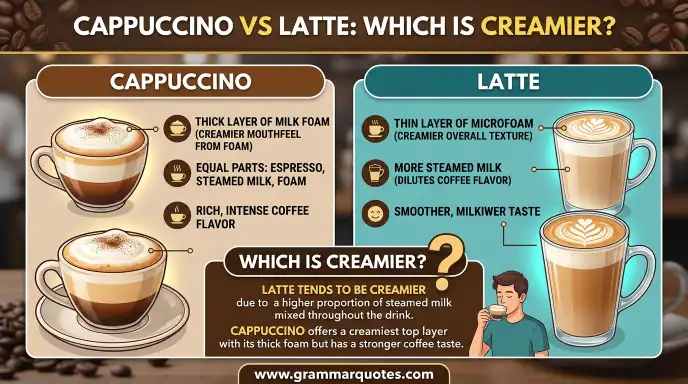
A latte is generally perceived as creamier because it contains more steamed milk. Its texture is smooth and fluid, with a relatively thin layer of foam.
A cappuccino has a lighter, airier texture because of its larger proportion of milk foam.
Which One Feels Smoother?
- Latte: Usually smoother and milkier.
- Cappuccino: Usually foamier and lighter on top.
The type of milk also affects texture. Whole milk, skimmed milk, and plant based alternatives can all produce different results.
Latte or Cappuccino: Which Is Stronger?
A cappuccino often tastes stronger because it contains less milk relative to the espresso in a typical serving.
However, strength can mean two different things: how intense the coffee tastes and how much caffeine the drink contains.
- Stronger flavour: A cappuccino often has a more pronounced espresso taste.
- More caffeine: Depends on the number of espresso shots and the coffee used.
For example, a latte with two espresso shots can contain more caffeine than a cappuccino with one shot, even if the cappuccino tastes stronger.
How Are Latte and Cappuccino Made?
Both drinks begin with espresso, but the milk preparation and final proportions differ.
How to Make a Latte
- Prepare one or more espresso shots.
- Steam milk until it becomes smooth and creamy.
- Pour the steamed milk into the espresso.
- Finish with a thin layer of milk foam.
The result is a creamy coffee drink with a balanced, relatively mild espresso flavour.
How to Make a Cappuccino
- Prepare one or more espresso shots.
- Steam and aerate the milk to create a generous layer of foam.
- Pour the steamed milk into the espresso.
- Finish with the characteristic foamy layer.
The result is a coffee drink with a more noticeable foam texture and a pronounced espresso flavour.
Latte vs Cappuccino: Common Mistakes to Avoid

1. Thinking a Latte and Cappuccino Are the Same
Both contain espresso and milk, but their proportions and textures are different.
Incorrect: A latte and cappuccino always contain exactly the same amount of milk and foam.
Correct: A latte generally contains more steamed milk, while a cappuccino traditionally has a thicker foam layer.
2. Assuming Cappuccino Always Has More Caffeine
A cappuccino does not automatically contain more caffeine than a latte.
Correct: Compare the number of espresso shots and the coffee recipe to estimate caffeine content.
3. Assuming Every Latte Is Served Hot
Lattes can also be served iced.
Example: I ordered an iced latte on a warm afternoon.
Cappuccinos are traditionally served hot, although variations and alternative preparations exist.
4. Confusing Milk Foam With Steamed Milk
Steamed milk and milk foam are related but not identical. Steamed milk is generally smoother and more liquid, while foam contains more air.
Correct: A latte usually has more liquid steamed milk, while a cappuccino typically features more foam.
5. Assuming One Drink Is Always Better
Taste is personal. Someone who prefers creamy coffee may enjoy a latte, while someone who likes a more pronounced espresso flavour may prefer a cappuccino.
Choose according to your taste rather than assuming one drink is universally superior.
Latte or Cappuccino: Which One Should You Choose?
Your choice depends on your preferred flavour, texture, and serving size.
| Your Preference | Recommended Drink |
| Smooth, creamy coffee | Latte |
| Thick milk foam | Cappuccino |
| Milder espresso flavour | Latte |
| More pronounced espresso flavour | Cappuccino |
| Flavoured coffee | Latte is a common option |
| Traditional foamy coffee | Cappuccino |
| Iced espresso and milk | Iced latte is widely available |
Choose a latte if you enjoy more milk and a smooth texture. Choose a cappuccino if you prefer a foamier drink with a more noticeable coffee flavour.
People Also Ask: Latte or Cappuccino
1. Is a latte or cappuccino stronger?
A cappuccino often tastes stronger because it typically contains less milk relative to the espresso. However, the actual strength depends on the recipe and number of espresso shots.
2. Which has more milk, a latte or cappuccino?
A latte generally contains more steamed milk. A cappuccino usually has a larger proportion of milk foam.
3. Which has more caffeine, a latte or cappuccino?
Neither automatically has more caffeine. If both contain the same espresso and number of shots, their caffeine content will generally be similar.
4. Is a latte sweeter than a cappuccino?
A latte may taste sweeter because its larger quantity of milk softens the espresso’s bitterness. However, neither drink necessarily contains added sugar. Syrups and other additions can change the sweetness.
5. Is a cappuccino healthier than a latte?
Neither is automatically healthier. Their nutritional content depends on serving size, milk type, added sugar, syrups, and the rest of your diet.
FAQs About Latte or Cappuccino
1. What is the main difference between a latte and a cappuccino?
A latte usually contains more steamed milk and a thin layer of foam, while a cappuccino traditionally contains espresso, steamed milk, and a thicker foam layer.
2. Which drink is better for beginners?
A latte may suit beginners who prefer a smooth, creamy, relatively mild coffee. A cappuccino may suit those who want to experience a more pronounced espresso flavour.
3. Can I make a latte or cappuccino without a coffee machine?
Yes. You can prepare strong coffee as a substitute for espresso and heat and froth milk separately. The flavour will differ from a drink made with a proper espresso machine.
4. Can I use oat milk or almond milk?
Yes. Both drinks can be made with plant based milk alternatives. The texture and foam quality depend on the product, and barista style versions are often designed to froth more effectively.
5. Which is more suitable for an iced coffee?
An iced latte is widely available and easy to customize. Iced cappuccino variations also exist, but their preparation and foam texture can vary by café.
Conclusion
When comparing latte or cappuccino, remember that both are espresso based coffee drinks, but their milk proportions and textures set them apart. A latte generally contains more steamed milk, giving it a smooth, creamy texture. A cappuccino typically has a thicker layer of foam and a more pronounced espresso flavour.
Neither drink is automatically stronger in caffeine or better for everyone. The number of espresso shots, milk type, serving size, and preparation method all affect the final result.
Final tip: Choose a latte for a milkier, smoother coffee or a cappuccino for a foamier drink with a noticeable espresso flavour.
Discover More Articles!
Appraise or Apprise: Meaning, Difference, and Examples
Palate or Palette: Meaning, Difference, and Examples
Untill or Until: Which Spelling Is Correct?(2026)

Ethan Parker is an English-language writer known for his interest in words, language, and clear communication. His work focuses on making everyday English easier to understand through simple explanations and practical examples.