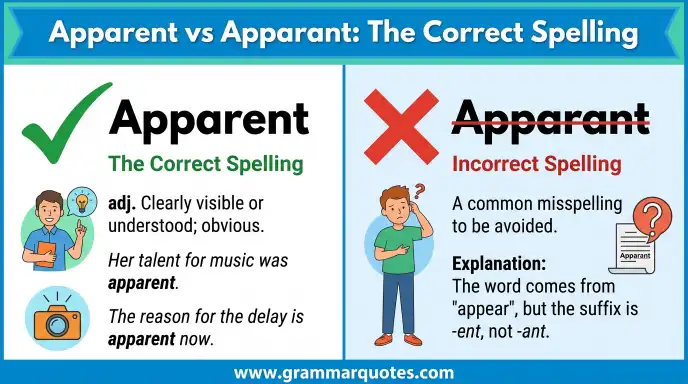
The correct spelling is apparent, not apparant. The word apparent means clear, obvious, or easy to notice. For example, if a student studies hard and gets the highest marks in class, it becomes apparent that the student worked well. Similarly, if someone looks worried, their feelings may be apparent from their facial expression.
People often misspell apparent because they confuse the vowel sounds and the spelling pattern in the middle of the word. This mistake can appear in school assignments, emails, essays, and online articles. Learning the correct spelling helps English learners write with greater confidence.
In this guide, you will learn the meaning, pronunciation, history, grammar, and synonyms of apparent. You will also discover common spelling mistakes, antonyms, and practical examples that make the difference easy to remember.
Meaning of Apparent
Definition
Apparent (Adjective): Apparent means clear, obvious, or easy to notice or understand.
It can also describe something that seems to be true based on what people can see, even when it may not be true.
Examples
- It was apparent that the student understood the lesson.
- The difference between the two pictures was apparent.
- His apparent happiness hid his real worries.
Connotative Meaning
Connotation (the feeling or idea associated with a word) depends on how apparent is used.
- Positive tone: It can suggest clarity or an easily recognized fact. Example: Her talent was apparent from the beginning.
- Negative tone: It can suggest that something only seems true or may be misleading. Example: His apparent confidence disappeared during the interview.
- Neutral tone: It can simply describe something that is easy to notice. Example: The damage was apparent after the storm.
Etymology
- Source language: Apparent comes from Latin apparens, meaning appearing or becoming visible.
- Latin root: It is connected to apparere, meaning to appear or become visible.
- Word development: The word entered English through Old French and Latin influences.
- Modern meaning: Today, apparent commonly means obvious, visible, or seemingly true.
Short History of Apparent
- Old English (450–1100): The modern word apparent was not a common part of Old English vocabulary. English speakers used other words to describe things that could be seen or understood.
- Middle English (1100–1500): Apparent entered English through French and Latin influence. It developed meanings related to visibility and what seemed to be true.
- Modern English (1500–Present): Apparent became widely used in everyday, academic, and formal English to describe clear facts, visible signs, and situations that seem to be true.
Pronunciation (US & UK – IPA)
- US: /əˈpærənt/
- UK: /əˈpærənt/
Syllables
ap par ent (3 syllables)
Affixation Pattern of Apparent
- Root: The word is historically related to the Latin verb apparere, meaning to appear.
- Prefix: No productive English prefix is added to apparent in its modern form.
- Suffix: The ending ent forms part of the adjective.
- Word formation: Related words include:
- Appear (verb): To become visible or seem to be something.
- Appearance (noun): The way someone or something looks.
- Apparent (adjective): Clear, obvious, or seemingly true.
- Apparently (adverb): In a way that seems true or according to what is known.
- Apparency (noun): The quality of being apparent; this is uncommon in everyday English.
- Reappear (verb): To appear again.
- Disappearance (noun): The act of vanishing or no longer being visible.
Apparant or Apparent: Which Spelling Is Correct?
Apparent (Correct Spelling)
Apparent is the correct English spelling. It means obvious, clear, or seemingly true.
Examples:
- The mistake was apparent to everyone.
- It became apparent that we needed more time.
Appar ant (Incorrect Spelling)
Appar ant is not the standard spelling of this English word. The common misspelling is apparant, which incorrectly uses an a instead of the second e.
Incorrect: The answer was apparant to the class.
Correct: The answer was apparent to the class.
Remember: Always write apparent, with an e after the second r.
Synonyms of Apparent
1. Obvious (Adjective)
US IPA: /ˈɑːbviəs/ | UK IPA: /ˈɒbviəs/
Meaning: Easy to see, understand, or recognize.
Examples:
- The answer was obvious to everyone.
- It was obvious that she had prepared well.
2. Clear (Adjective)
US IPA: /klɪr/ | UK IPA: /klɪə/
Meaning: Easy to understand or recognize.
Examples:
- The reason for the delay was clear.
- His explanation made the problem clear.
3. Evident (Adjective)
US IPA: /ˈevɪdənt/ | UK IPA: /ˈevɪdənt/
Meaning: Easy to notice because there are signs or facts that support it.
Examples:
- Her improvement was evident.
- It was evident that the team needed help.
4. Noticeable (Adjective)
US IPA: /ˈnoʊtɪsəbəl/ | UK IPA: /ˈnəʊtɪsəbəl/
Meaning: Easy to see or recognize.
Examples:
- There was a noticeable change in his behavior.
- The difference was noticeable from the start.
5. Visible (Adjective)
US IPA: /ˈvɪzəbəl/ | UK IPA: /ˈvɪzəbəl/
Meaning: Able to be seen.
Examples:
- The mountains were visible from our window.
- A visible crack appeared in the wall.
6. Plain (Adjective)
US IPA: /pleɪn/ | UK IPA: /pleɪn/
Meaning: Easy to understand or recognize.
Examples:
- It was plain that he was tired.
- The reason for her decision was plain.
7. Obvious to See (Phrase)
US IPA: /ˈɑːbviəs tə siː/ | UK IPA: /ˈɒbviəs tə siː/
Meaning: Easy to notice by looking.
Examples:
- The damage was obvious to see.
- Her excitement was obvious to see.
8. Manifest (Adjective)
US IPA: /ˈmænɪfest/ | UK IPA: /ˈmænɪfest/
Meaning: Clear or easy to recognize.
Examples:
- His concern was manifest in his voice.
- The benefits became manifest over time.
9. Noticeable (Adjective)
US IPA: /ˈnoʊtɪsəbəl/ | UK IPA: /ˈnəʊtɪsəbəl/
Meaning: Clear enough to attract attention.
Examples:
- Her progress was noticeable.
- A noticeable difference appeared after the repair.
10. Distinct (Adjective)
US IPA: /dɪˈstɪŋkt/ | UK IPA: /dɪˈstɪŋkt/
Meaning: Clearly different or easy to recognize.
Examples:
- There was a distinct change in the weather.
- The two voices sounded distinct.
11. Perceptible (Adjective)
US IPA: /pərˈseptəbəl/ | UK IPA: /pəˈseptəbəl/
Meaning: Possible to notice or detect.
Examples:
- There was a perceptible improvement in the service.
- A perceptible change occurred in the room’s temperature.
12. Recognizable (Adjective)
US IPA: /ˌrekəɡˈnaɪzəbəl/ | UK IPA: /ˌrekəɡˈnaɪzəbəl/
Meaning: Easy to identify or know.
Examples:
- Her voice was recognizable immediately.
- The building was recognizable from a distance.
13. Apparent (Adjective)
US IPA: /əˈpærənt/ | UK IPA: /əˈpærənt/
Meaning: Clear, obvious, or seemingly true.
Examples:
- The problem became apparent later.
- His apparent calmness surprised everyone.
14. Unmistakable (Adjective)
US IPA: /ˌʌnmɪˈsteɪkəbəl/ | UK IPA: /ˌʌnmɪˈsteɪkəbəl/
Meaning: So clear that it cannot easily be mistaken for something else.
Examples:
- Her voice was unmistakable.
- There was an unmistakable sign of progress.
15. Conspicuous (Adjective)
US IPA: /kənˈspɪkjuəs/ | UK IPA: /kənˈspɪkjuəs/
Meaning: Easy to notice, often because something stands out.
Examples:
- His bright jacket was conspicuous in the crowd.
- The error was conspicuous on the page.
16. Transparent (Adjective)
US IPA: /trænsˈpærənt/ | UK IPA: /trænsˈpærənt/
Meaning: Easy to understand or open about information and actions.
Examples:
- The company followed a transparent process.
- Her reasons for leaving were transparent.
17. Self Evident (Adjective)
US IPA: /ˌselfˈevɪdənt/ | UK IPA: /ˌselfˈevɪdənt/
Meaning: Clear without needing further explanation or proof.
Examples:
- The need for clean water is self evident.
- The answer seemed self evident to the teacher.
18. Unquestionable (Adjective)
US IPA: /ʌnˈkwestʃənəbəl/ | UK IPA: /ʌnˈkwestʃənəbəl/
Meaning: So certain that it is not reasonably doubted.
Examples:
- Her dedication was unquestionable.
- The evidence showed his unquestionable skill.
19. Certain (Adjective)
US IPA: /ˈsɜːrtən/ | UK IPA: /ˈsɜːtən/
Meaning: Known or believed to be true.
Examples:
- It was certain that the road was closed.
- We are certain about the final date.
20. Obvious Looking (Adjective)
US IPA: /ˈɑːbviəs ˈlʊkɪŋ/ | UK IPA: /ˈɒbviəs ˈlʊkɪŋ/
Meaning: Appearing easy to understand or recognize.
Examples:
- The obvious looking solution did not work.
- An obvious looking error appeared in the report.
21. Seeming (Adjective)
US IPA: /ˈsiːmɪŋ/ | UK IPA: /ˈsiːmɪŋ/
Meaning: Appearing to be true or real.
Examples:
- His seeming confidence hid his fear.
- The seeming simplicity of the task was misleading.
22. Ostensible (Adjective)
US IPA: /ɑːˈstensəbəl/ | UK IPA: /ɒˈstensəbəl/
Meaning: Appearing to be true or genuine, although the reality may be different.
Examples:
- His ostensible reason for leaving was work.
- The ostensible purpose of the visit was research.
23. Supposed (Adjective)
US IPA: /səˈpoʊzd/ | UK IPA: /səˈpəʊzd/
Meaning: Believed or claimed to be true, but not always proven.
Examples:
- The supposed expert could not answer the question.
- We visited the supposed location of the old castle.
24. Likely (Adjective)
US IPA: /ˈlaɪkli/ | UK IPA: /ˈlaɪkli/
Meaning: Expected or probable to happen or be true.
Examples:
- Rain is likely this evening.
- It is likely that the meeting will be delayed.
25. Understandable (Adjective)
US IPA: /ˌʌndərˈstændəbəl/ | UK IPA: /ˌʌndəˈstændəbəl/
Meaning: Easy to understand.
Examples:
- Her explanation was understandable.
- His disappointment was understandable after the result.
26. Revealing (Adjective)
US IPA: /rɪˈviːlɪŋ/ | UK IPA: /rɪˈviːlɪŋ/
Meaning: Showing information or facts that were not known before.
Examples:
- His expression was revealing.
- The interview provided revealing details about the event.
27. Noticeable to Everyone (Phrase)
US IPA: /ˈnoʊtɪsəbəl tə ˈevriwʌn/ | UK IPA: /ˈnəʊtɪsəbəl tə ˈevriwʌn/
Meaning: Easy for all people in a group to notice.
Examples:
- Her improvement was noticeable to everyone.
- The change in the classroom was noticeable to everyone.
28. Plainly Visible (Phrase)
US IPA: /ˈpleɪnli ˈvɪzəbəl/ | UK IPA: /ˈpleɪnli ˈvɪzəbəl/
Meaning: Clearly able to be seen.
Examples:
- The sign was plainly visible from the road.
- The damage was plainly visible after the accident.
29. Unambiguous (Adjective)
US IPA: /ˌʌnæmˈbɪɡjuəs/ | UK IPA: /ˌʌnæmˈbɪɡjuəs/
Meaning: Having only one clear meaning or interpretation.
Examples:
- The instructions were unambiguous.
- The contract included an unambiguous statement.
30. Decisive (Adjective)
US IPA: /dɪˈsaɪsɪv/ | UK IPA: /dɪˈsaɪsɪv/
Meaning: Settling a matter clearly or producing a definite result.
Examples:
- The team made a decisive improvement.
- The final test provided decisive evidence.
Prototype Meaning
The most typical meaning of apparent is clear or easy to notice. When people hear this word, they often imagine a fact, sign, or difference that can be recognized without much effort. For example, if a person is visibly upset, their feelings may be apparent. However, apparent can also describe something that only seems to be true. This second meaning is important because an apparent fact may not always match reality.
Prototype Categorization
The synonyms of apparent can be grouped according to their meanings.
- Clear and obvious: Obvious, clear, evident, manifest, and plain. These are useful when a fact is easy to understand.
- Easy to see: Visible, noticeable, conspicuous, and perceptible. These work best for physical signs and observable changes.
- Certain or definite: Unmistakable, unquestionable, self evident, and unambiguous. These suggest a high degree of clarity or certainty.
- Seeming rather than proven: Seeming, ostensible, and supposed. These words are useful when something appears true but may not be.
- Showing information: Revealing and transparent. These highlight the way actions, expressions, or information make something known.
Categorization helps writers choose the best synonym for the intended meaning. For example, visible suits something that can be seen, while ostensible suits a reason that is presented as genuine but may not be the real reason.
Antonyms of Apparent

- Hidden (adjective): Kept out of sight or not easily noticed.
- Obscure (adjective): Difficult to understand or recognize.
- Unclear (adjective): Not easy to understand.
- Unnoticeable (adjective): Difficult to see or detect.
- Concealed (adjective): Kept from being seen or known.
- Ambiguous (adjective): Having more than one possible meaning.
- Doubtful (adjective): Uncertain or not clearly established.
- Uncertain (adjective): Not known or decided for sure.
Common Mistakes: Apparent vs Apparant
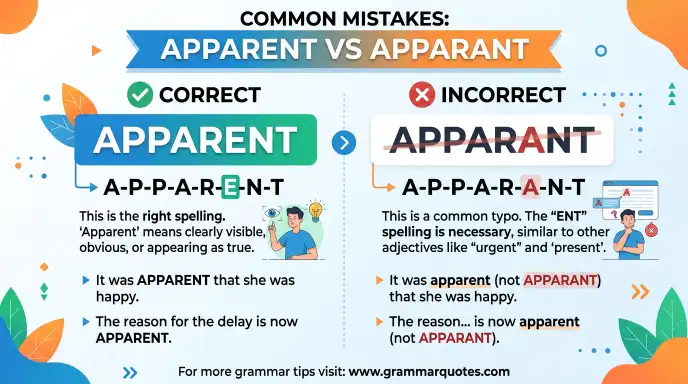
The most common spelling mistake is writing apparant instead of apparent.
- Incorrect: The answer was apparant.
- Correct: The answer was apparent.
- Incorrect: It became apparant that he was late.
- Correct: It became apparent that he was late.
Memory tip: Apparent contains the sequence a p p a r e n t. Remember the e after the second r.
Short Questions and Answers
- What does apparent mean?
Apparent means clear, obvious, or easy to notice. It can also mean seeming to be true. - When should apparent be used?
Use apparent when describing a fact, sign, or difference that is easy to recognize, or something that seems to be true. - Is apparent positive or negative?
Apparent is generally neutral. Its tone depends on the context. An apparent improvement sounds positive, while an apparent excuse may suggest doubt. - How is apparent different from obvious?
Obvious usually means easy to understand or recognize. Apparent can also mean something that seems true but may not be true in reality. - Is apparant a correct spelling?
No. Apparent is the correct spelling in standard English.
Conclusion
The correct spelling is apparent, while apparant is a common spelling error. Apparent means clear, obvious, or seemingly true. Understanding its meaning, pronunciation, word history, and synonyms helps English learners improve their vocabulary and writing skills.
Words such as obvious, evident, visible, and noticeable can replace apparent in suitable contexts. However, each synonym has a slightly different meaning, so it is important to choose carefully. Learning antonyms such as hidden, unclear, and obscure can also help you understand the word more fully.
To remember the spelling, focus on the letters in apparent, especially the e after the second r. Practice writing the word in sentences, read English articles regularly, and review new vocabulary each day. These simple habits can improve spelling accuracy, reduce repetition, and build confidence in English communication.
Discover More Articles!
Consigner or Consignor: Which Spelling Is Correct?(2026)
Vietnam or Thailand: Which Country Is Best for Your Travel Plans?
Minimize or Minimise: Which Spelling Is Correct and Examples

Ethan Parker is an English-language writer known for his interest in words, language, and clear communication. His work focuses on making everyday English easier to understand through simple explanations and practical examples.