Have you ever wondered if to write minimize or minimise? Both spellings are correct, but the right choice depends on the variety of English you are using. Minimize is the standard spelling in American English, while minimise is commonly used in British English and other varieties that follow British spelling conventions.
Both words have exactly the same meaning: to reduce something to the smallest possible amount, degree, or level. You can minimize expenses, minimise risks, or minimize the time spent on a task. The only difference is the spelling, not the meaning or pronunciation.
In this guide, you will learn the difference between minimize and minimise, their meanings, regional spelling rules, examples, common mistakes, and answers to frequently asked questions.
Quick Answer: Minimize or Minimise?
Both minimize and minimise are correct spellings. Choose the version that matches your preferred English style.
- Minimize: American English spelling.
- Minimise: British English spelling, also used in many other English speaking countries.
Examples:
- American English: We need to minimize our expenses.
- British English: We need to minimise our expenses.
Both sentences are grammatically correct and communicate the same idea.
Remember: Use minimize for American English and minimise for British English. Keep your spelling consistent throughout your writing.
What Does Minimize Mean?
Minimize means to reduce something as much as possible or to make its effect, amount, size, or importance as small as possible.
It is a verb commonly used in business, education, science, technology, and everyday conversations.
Examples of Minimize in Sentences
- We should minimize unnecessary expenses.
- The company wants to minimize production costs.
- Regular maintenance can minimize the risk of equipment failure.
- She tried to minimize distractions while studying.
- The new software helps minimize errors.
In each sentence, minimize describes an action that reduces something.
Synonyms for Minimize
Depending on the context, useful synonyms include:
- Reduce: To make something smaller or lower.
- Decrease: To make an amount or level go down.
- Lessen: To make something less intense or severe.
- Diminish: To make something smaller or weaker.
- Limit: To restrict the amount or extent of something.
- Lower: To reduce a level, price, or amount.
- Curtail: To reduce or restrict something.
These words have related meanings, but they are not always interchangeable. For example, limit often means setting a boundary, while minimize emphasizes reducing something as much as possible.
What Does Minimise Mean?
Minimise has exactly the same meaning as minimize. The difference is that minimise follows British English spelling conventions.
It means to reduce something to the smallest possible amount or to make its impact less significant.
Examples of Minimise in Sentences
- We must minimise waste in the workplace.
- The school introduced new rules to minimise distractions.
- Good planning can minimise the risk of delays.
- The government aims to minimise pollution.
- She adjusted her schedule to minimise stress.
These sentences are correct in British English and in other writing styles that use British spelling.
When Should You Use Minimise?
Use minimise when writing in British English or following a style guide that prefers British spellings.
For example:
- British academic writing
- Many publications in the United Kingdom
- Business documents following British English conventions
- English language content aimed at audiences in countries such as Australia and New Zealand
However, individual publishers and organizations may have their own style preferences.
Minimize vs. Minimise: Key Differences
The main difference between these words is regional spelling.
| Feature | Minimize | Minimise |
| English variety | American English | British English |
| Meaning | Reduce as much as possible | Reduce as much as possible |
| Pronunciation | The same | The same |
| Grammar | Verb | Verb |
| Correct spelling | Yes | Yes |
| Example | Minimize the cost. | Minimise the cost. |
The meaning, pronunciation, and grammatical function are the same. Only the spelling changes.
Minimize vs. Minimise: American and British English
English has several regional spelling conventions. Some words ending in ize in American English are commonly written with ise in British English.
American English: Minimize
American English generally uses ize in words such as minimize, organize, and realize.
Examples:
- We should minimize our spending.
- The manager wants to organize the files.
- I didn’t realize the mistake.
British English: Minimise
British English commonly uses ise in words such as minimise, organise, and realise.
Examples:
- We should minimise our spending.
- The manager wants to organise the files.
- I didn’t realise the mistake.
One important detail: British English also accepts many ize spellings, especially under Oxford spelling conventions. Therefore, minimize is not automatically incorrect in British English.
For the clearest regional distinction, use minimize for American English and minimise for British style writing when your chosen style guide prefers ise.
Why Do Minimize and Minimise Have Different Spellings?
The difference comes from historical spelling conventions in English.
The suffix ize has Greek roots and has long been used in English words that describe making something happen or causing a particular result. American English generally prefers ize in these words.
British English has traditionally used both ize and ise, but ise became especially common in many British publications and educational settings.
As a result, both spellings developed accepted uses.
Examples of similar spelling differences include:
| American English | British English |
| Minimize | Minimise |
| Organize | Organise |
| Realize | Realise |
| Recognize | Recognise |
| Apologize | Apologise |
| Prioritize | Prioritise |
| Standardize | Standardise |
| Categorize | Categorise |
These pairs generally have the same meanings. The difference is based on spelling preference rather than grammar.
How to Use Minimize and Minimise in Sentences

Both words can appear in many contexts. The spelling you choose should match your intended audience or writing style.
1. In Business
Businesses often try to minimize or minimise costs, delays, and risks.
- American: The company plans to minimize operating costs.
- British: The company plans to minimise operating costs.
2. In Education
Students can minimize distractions by creating a quiet study environment.
- American: Students should minimize distractions during exams.
- British: Students should minimise distractions during exams.
3. In Technology
Software developers often try to reduce errors and improve efficiency.
- American: The update will minimize technical problems.
- British: The update will minimise technical problems.
4. In Health and Safety
Organizations may take precautions to reduce risks.
- American: Proper training helps minimize workplace accidents.
- British: Proper training helps minimise workplace accidents.
5. In Everyday Conversations
The word can also describe ordinary efforts to reduce inconvenience.
- American: I want to minimize the time spent waiting.
- British: I want to minimise the time spent waiting.
Common Mistakes With Minimise or Minimize
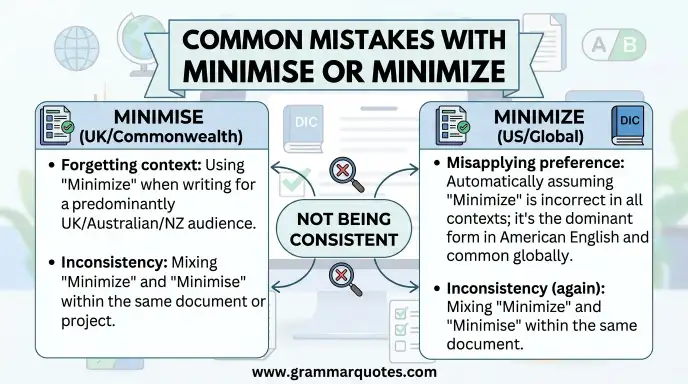
1. Thinking One Spelling Is Always Wrong
A common mistake is assuming that minimise is incorrect because American dictionaries use minimize, or that minimize is wrong because a British textbook uses minimise.
Both are accepted spellings. The best choice depends on the English variety and style guide.
2. Mixing American and British Spellings
Using minimize in one paragraph and organise in the next may create inconsistency if you are following a particular style.
Better approach: Choose one spelling convention and use it consistently.
3. Confusing Spelling With Meaning
Neither spelling changes the definition.
Incorrect assumption: Minimize means to reduce, but minimise has a different meaning.
Correct understanding: Both words mean to reduce something as much as possible.
4. Using Minimize When You Mean Eliminate
Minimize means to reduce something, not necessarily remove it completely.
Example: The new system will minimize errors.
This does not guarantee that all errors will disappear.
If you mean removing something entirely, eliminate may be more accurate.
5. Forgetting Related Spellings
If you use British style spelling, you may also prefer minimisation. American English generally uses minimization.
Keep related words consistent with the style you have selected.
Minimise or Minimize: Which Spelling Should You Choose?
The right spelling depends on your audience and the writing convention you follow.
| Situation | Recommended Spelling |
| American school assignment | Minimize |
| US business report | Minimize |
| British style school assignment | Minimise |
| UK publication using ise spellings | Minimise |
| Australian English writing | Usually minimise |
| Oxford style British writing | Minimize may be preferred |
| International website | Choose a style and remain consistent |
If you are unsure, follow the spelling used by your school, employer, publisher, or chosen style guide.
People Also Ask: Minimize or Minimise
1. Is minimize or minimise correct?
Both spellings are correct. Minimize is standard in American English, while minimise is common in British English and other varieties that follow ise spelling conventions.
2. Is minimise British or American English?
Minimise is commonly associated with British English. American English generally uses minimize.
3. Do minimize and minimise mean the same thing?
Yes. Both mean to reduce something to the smallest possible amount or degree. Their pronunciation and grammatical function are also the same.
4. Does British English use minimize or minimise?
British English uses both forms, depending on the publication or style guide. Many British publications prefer minimise, while Oxford spelling generally favours minimize.
5. What is the noun form of minimize or minimise?
The noun forms are minimization in American English and commonly minimisation in British English. Both refer to the process or act of reducing something.
FAQs About Minimize or Minimise
1. Which spelling is used in the United States?
The standard American English spelling is minimize.
Example: We need to minimize unnecessary spending.
2. Which spelling is used in the United Kingdom?
Minimise is common in British English, although minimize is also accepted under certain British spelling conventions.
Example: The team aims to minimise waste.
3. Is minimization or minimisation correct?
Both are correct. Minimization is the usual American spelling, while minimisation is common in British English styles that use ise spellings.
4. How do you pronounce minimize and minimise?
Both spellings are generally pronounced the same way. The spelling difference does not normally change the pronunciation.
5. Can I use minimize in an international article?
Yes. Choose the spelling convention that best suits your audience, then use it consistently throughout the article. For American focused content, use minimize. For British style content that prefers ise, use minimise.
Conclusion
When choosing between minimize or minimise, remember that both spellings are correct and have the same meaning. The difference comes from regional spelling conventions: American English generally uses minimize, while British English commonly uses minimise.
Use minimize for American audiences and minimise when following a British style spelling guide that prefers ise. Remember that some British publications, including those following Oxford spelling, prefer ize forms.
Final tip: Neither spelling is universally wrong. Choose the form that matches your audience, follow your preferred style guide, and remain consistent throughout your writing.
Discover More Articles!
Appraise or Apprise: Meaning, Difference, and Examples
Palate or Palette: Meaning, Difference, and Examples
Untill or Until: Which Spelling Is Correct?(2026)

Ethan Parker is an English-language writer known for his interest in words, language, and clear communication. His work focuses on making everyday English easier to understand through simple explanations and practical examples.