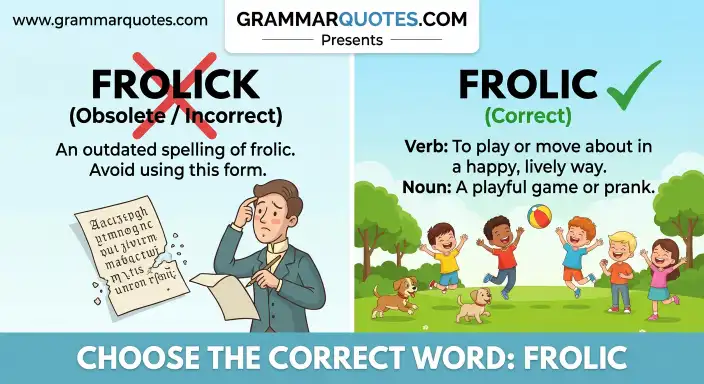
Frolic is the correct spelling, while frolick is a common misspelling that should generally be avoided. The word frolic means to play, run, jump, or move around in a happy and lively way. It can be used as both a verb and a noun.
For example, you can write, “The children frolic in the garden” or “The puppies enjoyed a playful frolic in the grass.” The confusion often comes from English spelling rules, especially when people think a word needs an extra “k” to keep its sound before certain endings. However, frolic already has the correct spelling without that extra letter.
When you add an ending, the final “c” often changes to “ck” to preserve the hard sound, as in frolicking and frolicked. In this guide, you will learn the difference between frolick and frolic, understand the correct spelling rules, explore practical examples, and discover how to use the word confidently in everyday, academic, and professional writing.
Frolick or Frolic: Quick Answer
Frolic is the correct standard spelling. Frolick is generally considered incorrect when used as the base form of the word.
Examples:
- Correct: The children frolic in the park.
- Incorrect: The children frolick in the park.
- Correct: The dogs love to frolic in the garden.
Remember this simple rule: Write frolic when using the base form, but use frolicked for the past tense and frolicking for the present participle.
What Does Frolic Mean?
Frolic means to play, move, or behave in a lively, cheerful, and playful way. It often describes children, animals, or people enjoying themselves without much concern.
The word can function as both a verb and a noun.
1. Frolic as a Verb
As a verb, frolic describes the action of playing or moving around happily.
Examples:
- The children frolic on the beach.
- The puppies frolic in the garden.
- The lambs frolic in the green fields.
- The students frolic during their break.
In these examples, the word describes lively and playful activity.
2. Frolic as a Noun
As a noun, frolic refers to a playful activity or a period of fun.
Examples:
- The children’s frolic made everyone smile.
- We watched the puppies during their afternoon frolic.
- The picnic ended with a cheerful frolic in the park.
The noun form is less common in everyday conversation than the verb, but it appears in stories, descriptions, and creative writing.
3. When Should You Use Frolic?
Use frolic when you want to describe joyful movement or playful behavior.
Common expressions include:
- Frolic in the garden
- Frolic on the beach
- Frolic in the snow
- Frolic through the fields
- Frolic with friends
- Frolic among the flowers
For example, “The children frolic in the snow” creates a picture of children playing happily outdoors.
The Origin of Frolic
The word frolic entered English through Dutch, with connections to the Dutch word vrolijk, meaning cheerful or merry. It became associated with playful behavior and lively enjoyment.
Over time, frolic developed into a standard English word used to describe joyful activity.
The spelling has remained frolic in its base form. The incorrect form frolick often appears because writers misunderstand how English changes the final letter when adding endings.
Why Do People Write Frolick?
English spelling rules can be confusing. Some words ending in a hard “c” add a “k” before certain endings to preserve the sound.
For example:
- Frolic → frolicked
- Frolic → frolicking
Because these forms contain “ck,” some writers mistakenly assume the base word should also contain a “k.”
However, the base form remains frolic.
Is Frolick Ever Correct?
In standard modern English, frolick is generally a misspelling of frolic. It should not be used as the ordinary base form in school assignments, professional documents, or published articles.
The correct forms are frolic, frolics, frolicked, and frolicking.
British English vs American English
Unlike words that have different British and American spellings, frolic is spelled the same way in both varieties of English.
| British English | American English | Example |
| Frolic | Frolic | The children frolic outside. |
| Frolics | Frolics | The puppy frolics in the grass. |
| Frolicked | Frolicked | The children frolicked on the beach. |
| Frolicking | Frolicking | The dogs are frolicking in the park. |
Is Frolic British or American?
Frolic is correct in both British and American English. Neither variety uses frolick as the standard base spelling.
Examples:
- British English: The lambs frolic in the fields.
- American English: The lambs frolic in the fields.
Both sentences are correct.
Do Frolic and Frolick Have Different Pronunciations?
No meaningful pronunciation difference is intended in ordinary usage. The problem is spelling, not pronunciation. The standard base form is frolic.
Does the Spelling Change in the Past Tense?
Yes. The final “c” changes to “ck” before certain endings to keep the hard “k” sound.
- Present: frolic
- Third person singular: frolics
- Past tense: frolicked
- Present participle: frolicking
This spelling pattern explains why frolicked and frolicking are correct even though frolick is not the standard base form.
Which Version Should You Use?
Always use frolic as the base form of the word.
United States
Use frolic in American English for the present tense and general use.
Example: The children frolic in the backyard.
United Kingdom
Use frolic in British English. The base spelling does not change across the Atlantic.
Example: The lambs frolic in the meadow.
Canada
Use frolic in Canadian English. It is the standard spelling in ordinary writing.
Example: The puppies frolic in the garden.
Australia
Use frolic in Australian English as well.
Example: The children frolic along the beach.
International Writing
Choose frolic for international audiences. It is the standard form and is widely understood.
Academic Writing
Use frolic in essays, assignments, and reports. If you need the past tense, use frolicked. If you need the present participle, use frolicking.
Business and Creative Writing
Although frolic is more common in descriptive and creative writing than in formal business documents, the same spelling rule applies everywhere.
Example: The campaign shows puppies frolicking in a sunny garden.
Common Mistakes
The most common mistake is adding an unnecessary “k” to the base form.
| Incorrect | Correct | Explanation |
| The children frolick outside. | The children frolic outside. | The base form ends in “c.” |
| She likes to frolick in the park. | She likes to frolic in the park. | Use frolic after “to.” |
| The puppy frolicks in the grass. | The puppy frolics in the grass. | The third person form is frolics. |
| The children frolickeed outside. | The children frolicked outside. | The past tense ends in “ icked.” |
Mistake 1: Adding K to the Base Form
Incorrect: The children frolick in the garden.
Correct: The children frolic in the garden.
The word already has the correct spelling without an extra “k.”
Mistake 2: Using Frolick After To
Incorrect: The puppies love to frolick outside.
Correct: The puppies love to frolic outside.
After to, use the base form of the verb.
Mistake 3: Thinking Frolicked Is Incorrect
Incorrect claim: Frolicked is wrong because frolick is wrong.
Correct explanation: Frolicked is correct. The “k” is added before the past tense ending to preserve the hard “c” sound.
Memory Tip
Remember the base form and its related forms:
- Frolic: Present or base form
- Frolics: Present tense with he, she, or it
- Frolicked: Past tense
- Frolicking: Present participle
The key rule is simple: Frolic is the base word; frolicked and frolicking take the extra “k.”
Everyday Examples of Frolic
1. Emails
- The children will frolic outside during the school picnic.
- We watched the puppies frolic in the garden.
- The event gives children time to frolic and enjoy outdoor games.
2. Business Writing
- The advertisement shows puppies frolicking in a sunny field.
- The campaign uses images of children frolicking outdoors.
- The resort promotes safe spaces where families can relax and frolic.
3. News Headlines
- Children Frolic in the Park During Spring Festival
- Puppies Frolic at Local Animal Shelter
- Lambs Frolic in Fields as Spring Arrives
4. Blogs
- Why Children Love to Frolic Outdoors
- Five Fun Ways for Puppies to Frolic Safely
- Beautiful Places Where Families Can Frolic in Nature
5. Social Media
- The puppies frolic in the garden every morning.
- We spent the afternoon frolicking on the beach.
- Little lambs frolic happily in the spring sunshine.
6. Academic Writing
- The young animals frolic in open spaces.
- The children frolicked during the outdoor activity.
- The observation recorded how the animals were frolicking in their enclosure.
7. Daily Conversation
- The kids love to frolic in the snow.
- The puppies are frolicking outside.
- We watched the lambs frolic in the field.
These examples show how the word can describe joyful movement in different situations.
Google Trends and Modern Usage
People search for “frolick or frolic” because the past tense forms frolicked and frolicking contain an extra “k.” This can make the base form confusing.
Which Spelling Is More Common?
Frolic is the standard base spelling in modern English. Frolick is generally a spelling mistake.
Without checking a specific Google Trends report, it would be inaccurate to provide exact search volumes or claim a numerical difference in popularity.
Why Do People Search for This Keyword?
Common reasons include:
- Checking the correct spelling for schoolwork.
- Learning how to form the past tense.
- Editing creative writing and stories.
- Understanding English spelling rules.
- Correcting grammar mistakes before publishing.
Which Spelling Should You Use Today?
Use frolic as the base form in all standard English varieties. When adding certain endings, use frolicked and frolicking.
Understanding this pattern helps you avoid errors and use the word correctly in everyday writing.
Frolick vs Frolic: Quick Comparison Table
| Version | Meaning | Correct? | Usage | Example |
| Frolic | Play or move about happily | Yes | Base form | The children frolic outside. |
| Frolick | Intended to mean play happily | No, nonstandard | Common misspelling | Avoid this spelling. |
| Frolics | Plays or moves about happily | Yes | Third person singular | The puppy frolics in the grass. |
| Frolicked | Played or moved about happily | Yes | Past tense | The children frolicked outside. |
| Frolicking | Playing or moving about happily | Yes | Present participle | The puppies are frolicking. |
Key Takeaways
- Frolic is the correct standard spelling of the base word.
- Frolick is generally considered a misspelling.
- Frolic means to play or move around happily.
- The word can function as both a noun and a verb.
- British and American English use the same base spelling.
- Frolicked is the correct past tense form.
- Frolicking is the correct present participle.
- Remember: the extra “k” appears in frolicked and frolicking, not in the base form.
People Also Ask
1. Is it frolick or frolic?
Frolic is the correct spelling. Frolick is generally considered a misspelling in standard English. Use frolic when describing someone playing, running, or moving around happily. For example, “The children frolic in the garden” is correct.
2. Why is frolicked spelled with a k?
The “k” is added before the past tense ending to preserve the hard “c” sound. The same rule applies to frolicking. However, the base form remains frolic, without the extra “k.”
3. What does frolic mean?
Frolic means to play, move, or behave in a lively and cheerful way. It often describes children or animals enjoying themselves. For example, “The puppies frolic in the grass” means the puppies play happily.
4. Is frolic correct in British and American English?
Yes. Frolic is the standard spelling in both British and American English. There is no regional spelling difference for the base form. The related forms frolicked and frolicking are also standard in both varieties.
5. What is the past tense of frolic?
The past tense of frolic is frolicked. For example, “The children frolicked on the beach yesterday.” The extra “k” is added before the ending to preserve the hard “c” sound.
FAQs
1. Is frolick a real word?
Frolick is generally treated as a misspelling of frolic in standard modern English. If you want to describe someone playing or moving around happily, use frolic. In formal writing, schoolwork, and published content, the standard spelling is the safest choice.
2. How do you spell frolic correctly?
The correct spelling is F R O L I C. It ends with the letter “c,” not “ck.” When you add certain endings, the spelling changes to frolicked or frolicking to preserve the hard “c” sound.
3. Is frolicking spelled with a k?
Yes. Frolicking is the correct spelling of the present participle of frolic. The “k” is added before “ ing” to keep the final consonant sound hard. For example, “The children are frolicking in the garden” is correct.
4. Can frolic be used as a noun?
Yes. Frolic can be both a verb and a noun. As a verb, it describes playing happily. As a noun, it refers to a playful activity or period of fun. For example, “The puppies enjoyed a frolic in the garden” uses the word as a noun.
5. What are some synonyms for frolic?
Common synonyms include play, romp, cavort, skip, prance, and gambol. The best choice depends on the context. For example, romp often suggests energetic play, while prance describes lively steps or movements. These words can help make descriptive writing more varied.
Conclusion
When choosing between frolick and frolic, the correct answer is frolic. It is the standard spelling in modern English and means to play, move, or behave in a happy and lively way. You can use it as both a noun and a verb in stories, everyday conversations, and descriptive writing.
The confusion usually comes from the related words frolicked and frolicking. These forms contain an extra “k” because English spelling adds it before certain endings to preserve the hard “c” sound. However, the base form never needs that extra letter.
Remember that frolic is correct in both British and American English. If you are writing an essay, a blog post, or a social media caption, use the standard spelling to keep your writing clear and accurate.
Final takeaway: Write frolic, not frolick. Add the “k” only in forms such as frolicked and frolicking. Explore more English spelling guides to strengthen your vocabulary and writing skills.
Discover More Articles!
Apparent or Apparent: Which Spelling Is Correct?(2026)
Latte or Cappuccino: Which One Should You Choose?
Gibberish or Jibberish: Which Spelling Is Correct?(2026)

Ethan Parker is an English-language writer known for his interest in words, language, and clear communication. His work focuses on making everyday English easier to understand through simple explanations and practical examples.