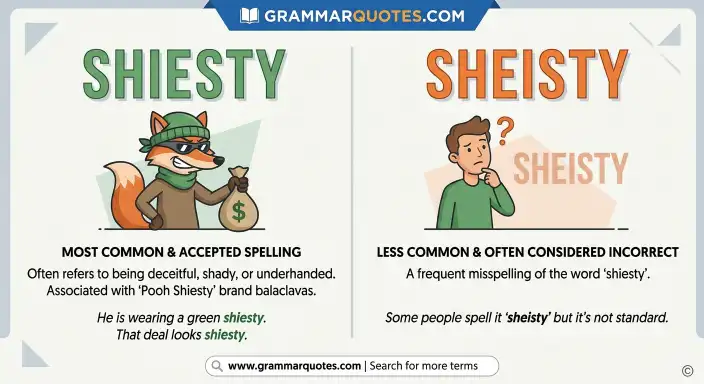
Shiesty and sheisty are two spellings of an informal slang word that describes someone who is dishonest, sneaky, or untrustworthy. However, shiesty is the more commonly recognized spelling in modern slang, while sheisty is a less common variant.
For example, you might say, “That was a shiesty move” to describe a dishonest action. The word is informal, so it is best suited to casual conversations, social media posts, and relaxed writing rather than formal or academic documents.
Quick Answer: Shiesty vs. Sheisty
- Shiesty: A common spelling of informal slang meaning dishonest, sneaky, or untrustworthy.
- Sheisty: A less common spelling variant with the same general meaning.
- Best choice: Use shiesty when writing modern informal slang, but remember that neither spelling is the standard formal English word for dishonest behavior.
What Does Shiesty Mean?
Shiesty is an informal slang adjective used to describe a person, action, or situation that seems dishonest, suspicious, or unfair.
People often use it when someone behaves in a sneaky way or does something that cannot be trusted.
Examples of Shiesty in Sentences
- That was a shiesty thing to do to your friend.
- I do not trust him because he seems shiesty.
- The seller made a shiesty deal and did not explain the conditions.
- She stopped working with the company after noticing its shiesty practices.
- It was a shiesty move to take credit for someone else’s work.
In these examples, shiesty describes dishonest or questionable behavior.
What Does Sheisty Mean?
Sheisty is an alternative spelling of shiesty. It is used in informal English with the same general meaning: dishonest, sneaky, or untrustworthy.
Although some people write sheisty, it is less commonly recognized than shiesty in modern slang.
Examples of Sheisty in Sentences
- That was a sheisty way to treat your customers.
- He made a sheisty excuse for missing the meeting.
- The deal sounded sheisty, so we decided not to accept it.
- I think that website looks a little sheisty.
- Her friend called the plan sheisty because it was unfair.
These sentences show how sheisty can be used as an informal alternative to shiesty.
Shiesty vs. Sheisty: Key Differences
| Feature | Shiesty | Sheisty |
| Meaning | Dishonest or sneaky | Dishonest or sneaky |
| Usage | More commonly recognized in modern slang | Less common spelling variant |
| Grammar | Informal adjective | Informal adjective |
| Formal writing | Usually avoid | Usually avoid |
| Example | That was a shiesty move. | That was a sheisty move. |
Important: The main difference is spelling and common usage, not meaning. Both forms can communicate the same idea in casual contexts.
Origin of Shiesty and Sheisty
The slang words shiesty and sheisty are associated with shyster, a word used for a person who behaves dishonestly, especially in business or legal dealings.
Over time, informal speech developed related spellings and pronunciations. The modern slang form shiesty is especially recognizable in casual conversations, online discussions, and popular culture.
The exact development and spelling history of these variants can be difficult to establish, so it is best not to treat one spelling as having a completely separate origin without reliable historical evidence.
British English vs American English
Neither shiesty nor sheisty is a standard formal spelling used consistently across British and American English. Both are informal slang variants.
| Context | Preferred approach |
| American informal slang | Shiesty is a commonly recognized choice |
| British informal English | Shiesty may be understood, but usage can vary |
| Academic writing | Use dishonest, deceitful, or untrustworthy |
| Professional communication | Choose a more formal synonym |
| Social media | Either spelling may appear, but shiesty is a practical choice |
Regional usage can vary, particularly online. If you want readers to understand your meaning clearly, use shiesty in casual slang or choose a more familiar synonym in formal writing.
Which Spelling Should You Use?
Choose shiesty if you want to use the more commonly recognized spelling of this informal slang term.
Use sheisty only when you intentionally want to reproduce that alternative spelling, such as when quoting someone or matching a particular informal style.
For formal writing, consider these alternatives:
- Dishonest: Not truthful or fair.
- Deceitful: Intentionally misleading.
- Untrustworthy: Not deserving of trust.
- Shady: Suspicious or questionable.
- Underhanded: Secretly unfair or dishonest.
For example, instead of writing, “The company used shiesty tactics,” you could write, “The company used deceitful tactics” in a formal report.
Common Mistakes When Using Sheisty and Shiesty
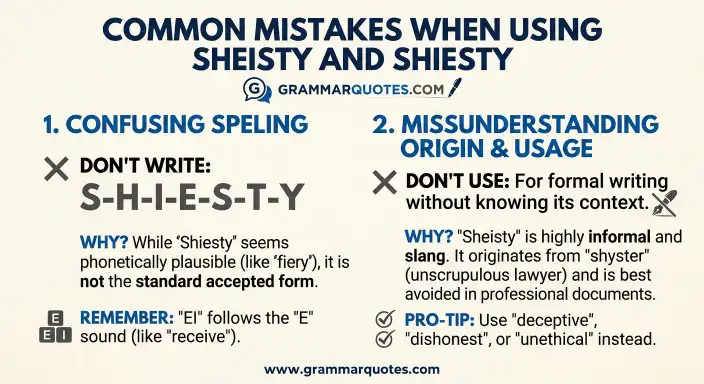
1. Treating Both Spellings as Formal English
Both forms are informal. In academic essays, business reports, and official documents, words such as dishonest or deceitful are usually more appropriate.
2. Assuming the Words Have Different Meanings
The spellings shiesty and sheisty generally communicate the same meaning. The difference is mainly their spelling and frequency of use.
3. Using Shiesty to Describe Every Bad Action
The word usually suggests dishonesty, sneakiness, or questionable behavior. It is not necessarily the best choice for every mistake or unkind action.
Incorrect context: “I forgot my notebook, so I was shiesty.”
Better: “I forgot my notebook, so I was careless.”
4. Confusing Shiesty With Shy
Although the words may look somewhat similar, they have different meanings. Shy describes someone who feels nervous or uncomfortable around other people, while shiesty describes dishonest or suspicious behavior.
5. Using Slang in Professional Writing
Slang can sound too casual in formal settings. Choose words that match your audience and purpose.
Everyday Examples of Shiesty
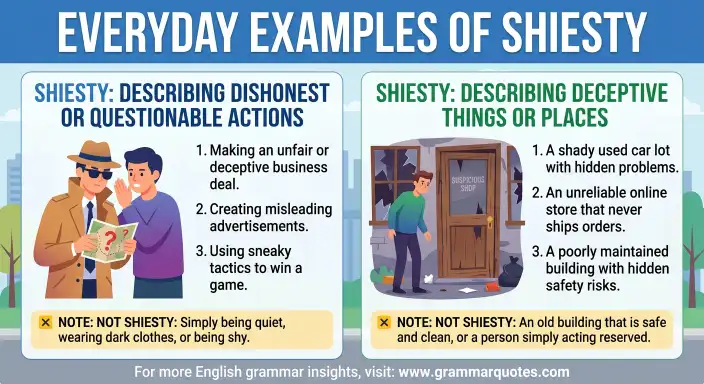
Here are some natural examples showing how shiesty appears in everyday informal English.
- Friendship: “It was shiesty of him to share her private message.”
- Business: “The seller’s shiesty behavior made customers suspicious.”
- Shopping: “That deal looks shiesty, so read the terms carefully.”
- Social media: “People called the decision shiesty in the comments.”
- Workplace: “Taking credit for another person’s work is a shiesty move.”
- Online safety: “The website seemed shiesty, so I avoided sharing personal information.”
These examples show that the word often describes behavior that appears dishonest or unfair.
Shiesty or Sheisty in Modern Usage
Both spellings can appear in informal writing, including social media comments, messages, and online conversations. However, shiesty is a practical choice if you want the more commonly recognized modern slang spelling.
There is no need to assume that one spelling is always used by every region or online community. Informal slang changes over time, and individual writers may use different variants.
If you are writing an article, school assignment, or professional message, consider your audience. A formal synonym will usually communicate the meaning more clearly to a wider range of readers.
Better Words to Use Instead of Shiesty
Depending on what you want to express, these alternatives may work better:
| Word | Meaning | Example |
| Dishonest | Not truthful | The seller was dishonest about the price. |
| Deceitful | Intentionally misleading | His deceitful behavior damaged the relationship. |
| Shady | Suspicious or questionable | That offer sounds shady. |
| Sneaky | Acting secretly, often unfairly | It was sneaky to change the agreement without telling us. |
| Untrustworthy | Not deserving of trust | The source seemed untrustworthy. |
| Underhanded | Secretly unfair | The competitor used underhanded tactics. |
| Fraudulent | Involving deception for unlawful gain | The company was investigated for fraudulent activity. |
Use shiesty for casual slang and choose a more precise synonym when clarity or professionalism matters.
People Also Ask About Shiesty or Sheisty
1. Is shiesty or sheisty the correct spelling?
Shiesty is the more commonly recognized spelling in modern informal slang. Sheisty is a less common variant.
2. What does shiesty mean in slang?
Shiesty means dishonest, sneaky, suspicious, or untrustworthy. It often describes a questionable action or a person whose behavior cannot be trusted.
3. Is sheisty a real word?
Sheisty is used as an informal spelling variant of shiesty. However, it is not a standard formal English spelling.
4. Is shiesty a formal English word?
No. Shiesty is informal slang. In professional or academic writing, words such as dishonest, deceitful, or untrustworthy are generally better choices.
5. Can I use shiesty in a sentence?
Yes. For example: “It was a shiesty move to hide the extra charges from customers.” The word is appropriate for casual conversation and informal writing.
Frequently Asked Questions (FAQs)
1. Which word should I use: shiesty or sheisty?
Use shiesty when you want the more commonly recognized spelling of the informal slang word. Use sheisty when reproducing that alternative spelling intentionally.
2. Do shiesty and sheisty mean the same thing?
Yes. Both generally mean dishonest, sneaky, or untrustworthy. Their main difference is spelling and common usage.
3. Is shiesty an adjective?
Yes. It is an informal adjective used to describe a person, action, deal, or situation that seems dishonest or suspicious.
4. What is a synonym for shiesty?
Common synonyms include dishonest, shady, deceitful, sneaky, and untrustworthy. The best synonym depends on the context.
5. Should I use shiesty in a school essay?
It is usually better to avoid slang in a formal school essay unless the assignment discusses slang or informal language. Use dishonest, deceitful, or untrustworthy instead.
Conclusion
When comparing shiesty or sheisty, shiesty is the more commonly recognized choice in modern informal slang. Both spellings generally describe dishonest, sneaky, or untrustworthy behavior, but neither is the best option for formal writing. If you are writing a social media post or having a casual conversation, shiesty is a practical choice.
For school assignments, professional documents, and academic articles, words such as dishonest, deceitful, and untrustworthy will usually sound clearer and more appropriate. Choosing the right word helps you communicate your meaning accurately and match the tone of your writing.
Discover More Articles!
Much vs Many: Meaning, Differences, Grammar Rules, and Examples
Latte or Cappuccino: Which One Should You Choose?
Apparent or Apparent: Which Spelling Is Correct?(2026)

Ethan Parker is an English-language writer known for his interest in words, language, and clear communication. His work focuses on making everyday English easier to understand through simple explanations and practical examples.