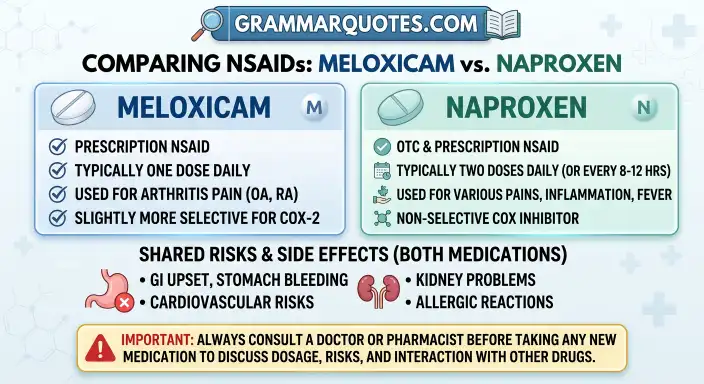
Meloxicam and naproxen are both nonsteroidal anti inflammatory drugs (NSAIDs) used to relieve pain and reduce inflammation, but they are not the same medication. Meloxicam is commonly prescribed for conditions such as osteoarthritis and rheumatoid arthritis, while naproxen is used for various types of pain and inflammatory conditions, including arthritis and some muscle or joint problems.
Both medicines can cause side effects, including stomach irritation, ulcers, bleeding, and kidney problems. They can also increase the risk of cardiovascular complications in some people. The better option depends on the condition being treated, a person’s medical history, other medications, and professional medical advice. Understanding their differences can help you discuss suitable treatment options with a healthcare professional.
Quick Answer: Meloxicam or Naproxen?
Both meloxicam and naproxen are NSAIDs, but they differ in their typical uses, dosing schedules, and available formulations.
- Meloxicam: A prescription NSAID commonly used to manage pain and inflammation associated with osteoarthritis and rheumatoid arthritis.
- Naproxen: An NSAID available in prescription and some over the counter forms, depending on the product and country. It is used for several types of pain and inflammation.
Important: Neither medication is automatically safer or more effective for everyone. Do not take them together unless a healthcare professional specifically directs you to do so, because combining NSAIDs can increase the risk of serious side effects.
Definition and Meaning of Meloxicam
Meloxicam is a nonsteroidal anti inflammatory drug used to reduce pain, swelling, and inflammation. It works by inhibiting enzymes called cyclooxygenases (COX), which contribute to the production of prostaglandins involved in pain and inflammation.
Meloxicam is commonly prescribed for certain inflammatory joint conditions. Its suitability depends on the patient’s diagnosis, age, medical history, and other medicines.
Common Uses of Meloxicam
Healthcare professionals may prescribe meloxicam for:
- Osteoarthritis symptoms.
- Rheumatoid arthritis symptoms.
- Certain inflammatory joint conditions, depending on the formulation and indication.
Meloxicam may help improve comfort and movement by reducing inflammation, but it does not cure arthritis or reverse underlying joint damage.
Examples of Meloxicam in Sentences
- The doctor prescribed meloxicam to help manage the patient’s arthritis symptoms.
- Meloxicam can reduce pain and inflammation in certain joint conditions.
- A healthcare professional reviewed the patient’s medical history before prescribing meloxicam.
- The pharmacist explained the possible side effects of meloxicam.
- Patients should follow the instructions provided with their meloxicam prescription.
Important Safety Information About Meloxicam
Meloxicam can cause side effects, including stomach discomfort, nausea, and dizziness. More serious risks include gastrointestinal bleeding, kidney problems, fluid retention, increased blood pressure, and heart related complications.
People with a history of stomach ulcers, kidney disease, heart disease, or certain medication allergies should discuss these risks with a healthcare professional before using it.
Definition and Meaning of Naproxen
Naproxen is another nonsteroidal anti inflammatory drug used to relieve pain and reduce inflammation. Like meloxicam, it works by reducing the production of prostaglandins involved in inflammatory responses.
Depending on the formulation and country, naproxen may be available by prescription or without a prescription. Different products can have different strengths and instructions, so the packaging and professional guidance matter.
Common Uses of Naproxen
Naproxen may be used to help manage:
- Osteoarthritis and rheumatoid arthritis symptoms.
- Certain muscle and joint pains.
- Menstrual cramps.
- Tendon or bursa inflammation.
- Some types of acute pain, when appropriate.
The specific uses depend on the product, a person’s age, and their health circumstances.
Examples of Naproxen in Sentences
- The doctor recommended a suitable treatment for the patient’s joint pain.
- Naproxen is used to relieve pain and inflammation in several conditions.
- The pharmacist explained the directions for the naproxen product.
- Some people use naproxen for menstrual cramps when it is appropriate for them.
- Patients should check with a healthcare professional before combining naproxen with other medicines.
Important Safety Information About Naproxen
Naproxen can cause stomach upset, heartburn, nausea, and dizziness. Serious risks can include stomach or intestinal bleeding, kidney problems, fluid retention, increased blood pressure, and cardiovascular complications.
People who take blood thinners, have a history of ulcers, have kidney or heart conditions, or are pregnant should seek professional advice before using naproxen. NSAIDs can pose particular risks during pregnancy, especially from around 20 weeks onward.
Key Differences Between Meloxicam and Naproxen
Meloxicam and naproxen belong to the same broad medication class, but they have some practical differences.
| Feature | Meloxicam | Naproxen |
| Medication class | NSAID | NSAID |
| Main purpose | Pain and inflammation relief | Pain and inflammation relief |
| Common uses | Arthritis and certain joint conditions | Arthritis and several other pain conditions |
| Availability | Generally prescription only in many countries | Prescription and over the counter forms, depending on the country and product |
| Dosing schedule | Often taken once daily, according to the prescription | Schedule varies by formulation and reason for use |
| Duration of action | Relatively long acting | Also relatively long acting |
| Possible side effects | Stomach, kidney, blood pressure, and cardiovascular risks | Stomach, kidney, blood pressure, and cardiovascular risks |
| Suitable for everyone? | No | No |
Neither medicine should be selected solely because of its dosing schedule or availability. A healthcare professional can help determine which option is appropriate for a particular condition.
Which Is Better: Meloxicam or Naproxen?
There is no single answer for everyone. The most appropriate medicine depends on the type of pain, its cause, existing medical conditions, and other medications.
When Meloxicam May Be Considered
A healthcare professional may consider meloxicam for ongoing symptoms associated with certain inflammatory joint conditions, such as osteoarthritis or rheumatoid arthritis.
The decision depends on if an NSAID is appropriate and if the expected benefits outweigh its risks.
When Naproxen May Be Considered
Naproxen may be considered for some types of acute pain, menstrual cramps, or inflammatory conditions, as well as arthritis. Its suitability depends on the product and the person’s circumstances.
Which One Has Fewer Side Effects?
Neither medication is consistently safer for every person. Both can cause serious gastrointestinal, kidney, and cardiovascular side effects.
Individual risk can vary based on age, dose, duration of use, medical history, and other medicines. A clinician or pharmacist can help assess those factors.
Can You Take Meloxicam and Naproxen Together?
Do not take meloxicam and naproxen together unless your healthcare professional specifically instructs you to do so.
Both medicines are NSAIDs. Combining them generally increases the risk of side effects without necessarily providing additional pain relief.
Potential risks include:
- Stomach ulcers and gastrointestinal bleeding.
- Kidney injury.
- Fluid retention and increased blood pressure.
- Cardiovascular complications.
If you have already taken both medicines, contact a pharmacist, doctor, or local poison information service for advice about your specific circumstances. Seek urgent medical care if you develop severe symptoms such as vomiting blood, black stools, chest pain, difficulty breathing, or fainting.
Common Side Effects of Meloxicam and Naproxen
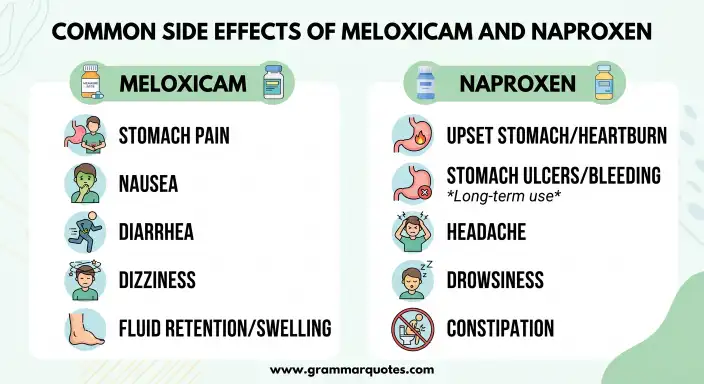
Because both medicines belong to the same class, they share several possible side effects.
Common Side Effects
Depending on the medication and individual, these may include:
- Stomach discomfort.
- Nausea.
- Heartburn or indigestion.
- Headache.
- Dizziness.
- Swelling caused by fluid retention.
Serious Side Effects
Both medicines can sometimes cause serious complications, including:
- Gastrointestinal ulcers or bleeding.
- Kidney damage.
- Severe allergic reactions.
- Increased blood pressure.
- Heart attack or stroke.
Seek urgent medical help for symptoms suggesting a serious allergic reaction, gastrointestinal bleeding, heart attack, or stroke.
Who Should Seek Medical Advice Before Using These Medicines?
Before using meloxicam or naproxen, speak with a healthcare professional if you:
- Have a history of stomach ulcers or gastrointestinal bleeding.
- Have kidney disease, heart disease, or high blood pressure.
- Take blood thinners or other medicines that may interact with NSAIDs.
- Have asthma or a previous allergic reaction to aspirin or another NSAID.
- Are pregnant, trying to become pregnant, or breastfeeding.
- Are older or have several ongoing medical conditions.
Do not assume that a medicine available without a prescription is risk free. Always check the label and follow the appropriate medical advice.
British English vs American English
Meloxicam and naproxen are medication names, not words with different British and American spellings. Their spellings remain the same in both varieties of English.
| Feature | British English | American English |
| Medication name | Meloxicam | Meloxicam |
| Medication name | Naproxen | Naproxen |
| Spelling difference | None | None |
| General meaning | Names of NSAID medicines | Names of NSAID medicines |
Product names, approved uses, strengths, and availability may differ by country, but the generic names are spelled the same way.
Common Mistakes About Meloxicam and Naproxen
Mistake 1: Assuming Both Medicines Are Identical
Incorrect: Meloxicam and naproxen are exactly the same medicine.
Correct: They belong to the same drug class but are different medicines.
Explanation: They have different prescribing instructions and may be used in different situations.
Mistake 2: Assuming One Is Always Safer
Incorrect: Meloxicam is always safer than naproxen.
Correct: Safety depends on the person’s health, other medicines, and treatment plan.
Explanation: Both medications can cause serious adverse effects.
Mistake 3: Combining Them for Extra Pain Relief
Incorrect: Taking both NSAIDs together is a good way to increase pain relief.
Correct: Do not combine them unless specifically instructed by a healthcare professional.
Explanation: Using two NSAIDs together can increase the risk of harmful side effects.
Mistake 4: Ignoring Product Instructions
Incorrect: All naproxen products have identical directions.
Correct: Follow the directions for the exact product and formulation.
Explanation: Strengths, formulations, and approved instructions can differ.
Everyday Examples of Meloxicam and Naproxen
These examples show how the medication names are used in everyday medical communication. They are not personal treatment recommendations.
Examples of Meloxicam
- The doctor discussed meloxicam as one possible treatment for arthritis symptoms.
- The pharmacist reviewed the patient’s other medicines before dispensing meloxicam.
- The patient asked about the possible side effects of meloxicam.
- The healthcare professional explained why meloxicam should not be combined with another NSAID without advice.
- The patient followed the directions on the meloxicam prescription.
Examples of Naproxen
- The pharmacist explained the correct instructions for the naproxen product.
- The patient asked if naproxen was suitable for their medical history.
- The doctor discussed the benefits and risks of naproxen.
- The patient checked if naproxen could interact with another medicine.
- The healthcare professional explained the warning signs of serious side effects.
Google Trends and Search Interest
People may search for “meloxicam or naproxen” when comparing pain medicines, researching arthritis treatments, or trying to understand the differences between two prescribed or available medications.
Search interest may vary depending on health concerns, medical advice, and public awareness. However, without reviewing current Google Trends data, it would be inaccurate to claim that one medicine is searched for more often or is more popular than the other.
Online comparisons can provide general information, but they cannot determine which medication is appropriate for an individual. A qualified healthcare professional can consider personal risk factors and recommend suitable options.
People Also Ask (PAA)
1. Is Meloxicam the Same as Naproxen?
No. Both are NSAIDs that reduce pain and inflammation, but they are different medicines with different prescribing instructions and available formulations.
2. Which Is Better for Arthritis: Meloxicam or Naproxen?
Both may help relieve arthritis symptoms. The better choice depends on the type of arthritis, medical history, other medications, and individual risks. A healthcare professional can help decide which is suitable.
3. Can You Take Meloxicam and Naproxen Together?
Generally, no. Taking two NSAIDs together can increase the risk of stomach bleeding, kidney problems, and other serious side effects. Only combine them if specifically instructed by a healthcare professional.
4. Does Meloxicam Last Longer Than Naproxen?
Both medicines have relatively long lasting effects, but how long their effects last can vary by formulation and individual circumstances. Follow the prescribed instructions rather than changing the schedule yourself.
5. Are Meloxicam and Naproxen Available Without a Prescription?
Availability depends on the country and product. Meloxicam is generally prescription only in many countries, while some naproxen products are available over the counter. Check local regulations and consult a pharmacist.
Frequently Asked Questions (FAQs)
1. What Is the Main Difference Between Meloxicam and Naproxen?
Both medicines reduce pain and inflammation. Their main differences include their approved uses, formulations, dosing instructions, and availability. Neither is the best choice for everyone.
2. Which Medicine Has More Side Effects?
There is no universal answer. Both can cause stomach irritation, ulcers, bleeding, kidney problems, increased blood pressure, and cardiovascular complications. Individual risks vary.
3. Can Meloxicam or Naproxen Cause Stomach Problems?
Yes. Both can cause indigestion, stomach ulcers, and gastrointestinal bleeding. The risk may be higher in people with a history of ulcers or those taking certain other medicines.
4. Should You Take These Medicines With Food?
Follow the instructions provided with the specific medicine. Taking an NSAID with food may reduce stomach discomfort for some people, but it does not eliminate the risk of ulcers or bleeding.
5. Can You Switch From Meloxicam to Naproxen?
A healthcare professional can advise if switching is appropriate and explain how to do it safely. Do not overlap the medicines or change your treatment plan without medical guidance.
Conclusion
Meloxicam and naproxen are both NSAIDs used to reduce pain and inflammation, but they are different medications with different uses, formulations, and prescribing instructions. Meloxicam is commonly prescribed for certain inflammatory joint conditions, while naproxen is used for arthritis and several other types of pain.
Both medicines can cause serious side effects, including gastrointestinal bleeding, kidney problems, and cardiovascular complications. Neither is automatically safer or more effective for everyone. Most importantly, do not take meloxicam and naproxen together unless a healthcare professional specifically instructs you to do so. For a safe and suitable treatment choice, discuss your symptoms, medical history, and other medications with a doctor or pharmacist.
Discover More Articles!
Defences or Defenses: Which Spelling Is Correct?(2026)
Finasteride or Propecia: Understanding the Difference Between Them
Publicly or Publically: Which Spelling Is Correct?

Ethan Parker is an English-language writer known for his interest in words, language, and clear communication. His work focuses on making everyday English easier to understand through simple explanations and practical examples.