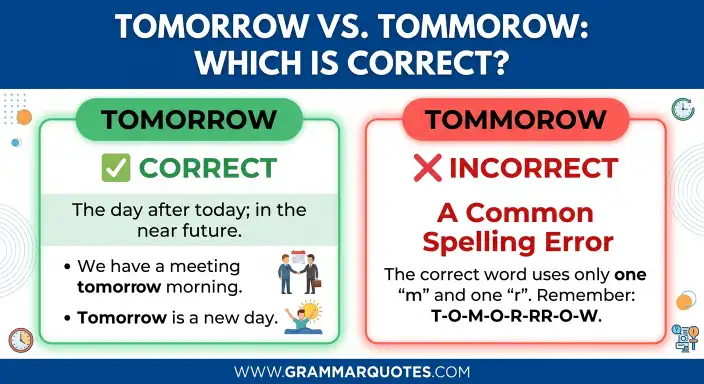
Is it tomorrow or tommorow? The correct spelling is tomorrow, with one m and two rs. Tommorow is a common spelling mistake and is not the standard English spelling.
The word tomorrow refers to the day after today. It can also be used when talking about something that will happen in the near future. People use it every day when discussing plans, school, work, meetings, and special events.
Learning the correct spelling of tomorrow can help you write better English and avoid common mistakes. In this guide, you will learn its meaning, pronunciation, examples, word forms, and common spelling errors. You will also find simple tips to remember the correct spelling.
Quick Answer: Tomorrow or Tommorow?
Tomorrow is the correct spelling.
Tommorow is incorrect because it contains an extra m.
- Correct: I will call you tomorrow.
- Incorrect: I will call you tommorow.
Easy memory tip: Remember that tomorrow has one m and two rs.
What Does Tomorrow Mean?
Definition of Tomorrow
Tomorrow is an adverb and a noun. It usually means the day after today.
As an adverb, it tells us when something will happen. As a noun, it can refer to the next day or, in a broader sense, the future.
Examples of Tomorrow in Sentences
- I will finish my homework tomorrow.
- We are going to visit our grandparents tomorrow.
- The meeting is scheduled for tomorrow morning.
- She hopes for a better tomorrow.
- Tomorrow is another day to learn something new.
Connotative Meaning of Tomorrow
The word tomorrow can suggest hope, opportunity, planning, or the future. Its meaning depends on the context.
For example:
- I will see you tomorrow. This refers to the next day.
- Tomorrow brings new opportunities. This uses tomorrow to represent the future.
Origin and Short History of Tomorrow
The word tomorrow developed from an older English expression meaning “on the morrow.” The word morrow referred to the following day or morning.
Over time, the expression became the single word tomorrow. Today, it is used in everyday English to refer to the day after today and sometimes to the future more generally.
Pronunciation of Tomorrow
- American English IPA: /təˈmɑːroʊ/
- British English IPA: /təˈmɒrəʊ/
- Syllables: Three — to mor row
- Part of speech: Noun and adverb
The exact vowel sounds differ between American and British English, but the spelling remains the same.
Word Forms and Related Words
Tomorrow does not have a regular plural or verb form. However, several related words and expressions are useful.
- Today: The current day.
- Yesterday: The day before today.
- Tomorrow morning: The morning of the next day.
- The day after tomorrow: Two days from today.
- Tomorrow’s: The possessive form, as in “tomorrow’s meeting.”
Example: I have prepared everything for tomorrow’s class.
Tommorow vs Tomorrow: Key Differences
| Feature | Tomorrow | Tommorow |
| Correct spelling | Yes | No |
| Standard English word | Yes | No, when intended to mean the next day |
| Number of m’s | One | Two |
| Number of r’s | Two | One |
| Example | See you tomorrow. | See you tommorow. |
The most important difference is the spelling. Always write tomorrow with one m and two rs.
Why Do People Spell Tomorrow Incorrectly?
Many people write tommorow because they remember the sound of the word but forget the correct letter pattern. The repeated sounds in the middle can make the spelling confusing.
Another reason is typing quickly. People may accidentally add an extra letter without noticing.
To avoid this mistake, remember the spelling pattern:
T O M O R R O W
Say the letters slowly or write the word a few times while checking the spelling.
Common Mistakes With Tomorrow
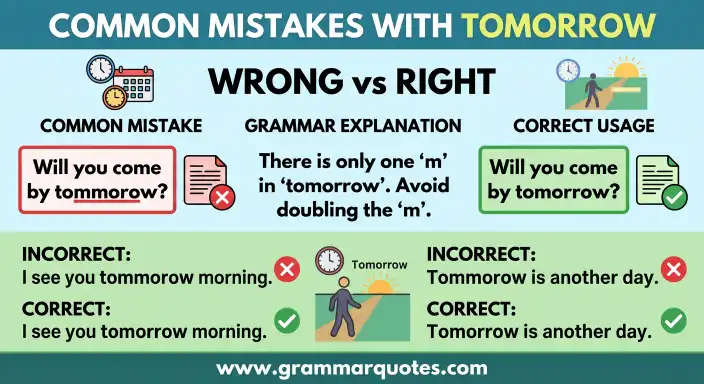
Mistake 1: Adding an Extra M
Incorrect: I will complete the task tommorow.
Correct: I will complete the task tomorrow.
Why? The correct spelling contains only one m.
Mistake 2: Using Only One R
Incorrect: I will see you tomorow.
Correct: I will see you tomorrow.
Why? The correct spelling has two rs.
Mistake 3: Confusing Tomorrow With Today
Incorrect: I will submit the assignment tomorrow when I mean today.
Correct: I will submit the assignment today. (If you plan to submit it on the current day.)
Why? Today means the current day, while tomorrow means the following day.
Mistake 4: Confusing Tomorrow With The Day After Tomorrow
Tomorrow means the next day. The day after tomorrow means two days from today.
Example: If today is Monday, tomorrow is Tuesday, and the day after tomorrow is Wednesday.
Everyday Examples of Tomorrow in Sentences
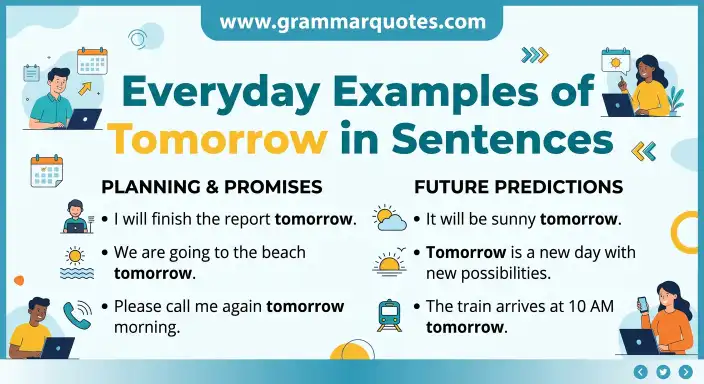
Simple Sentences
- I will go to school tomorrow.
- We have an English test tomorrow.
- My brother will arrive tomorrow.
- She plans to clean her room tomorrow.
- They will play cricket tomorrow evening.
Questions Using Tomorrow
- Are you coming tomorrow?
- What will you do tomorrow?
- Will the shop open tomorrow?
- Do we have a class tomorrow?
- Can you help me tomorrow?
Sentences About the Future
- Tomorrow is a new opportunity to improve.
- We hope for a brighter tomorrow.
- The team will begin its work tomorrow.
- I am looking forward to seeing you tomorrow.
- A little preparation today can make tomorrow easier.
Synonyms and Related Expressions for Tomorrow
There is no perfect synonym for tomorrow when it means the specific day after today. However, these expressions may be useful in related contexts.
- The next day: The day following a particular day.
- The following day: A formal expression for the next day.
- The day after today: A direct explanation of tomorrow.
- In the future: At a later time, not necessarily the next day.
- The day after tomorrow: Two days from today, so it is not an exact synonym.
Example: We will continue the project the following day.
Remember that in the future can refer to any later time, while tomorrow usually refers to one specific day.
Frequently Asked Questions
1. Is It Tomorrow or Tommorow?
Tomorrow is correct. Tommorow is a common misspelling.
2. How Do You Spell Tomorrow Correctly?
Spell it T O M O R R O W. It has one m and two rs.
3. Why Is Tomorrow Difficult to Spell?
People often confuse the number of letters in the middle. Practising the correct spelling can help prevent this mistake.
4. What Does Tomorrow Mean in Simple English?
Tomorrow means the day after today.
5. What Is the Difference Between Tomorrow and the Day After Tomorrow?
Tomorrow is the next day. The day after tomorrow is two days from today.
6. Is Tomorrow a Noun or an Adverb?
It can be both. In “I will leave tomorrow,” it is an adverb. In “Tomorrow is a new day,” it is a noun.
7. Does American English Spell Tomorrow Differently From British English?
No. Both American and British English use the spelling tomorrow. Pronunciation may differ, but the spelling stays the same.
Conclusion
The correct spelling is tomorrow, not tommorow. It means the day after today and is commonly used when talking about plans, appointments, school, work, and future events.
To remember the spelling, keep one simple rule in mind: tomorrow has one M and two Rs. Write it as T O M O R R O W, and check the word when editing your work.
Using the correct spelling makes your writing clearer and more professional. if you are writing a school assignment, sending a message, or creating website content, always use tomorrow. With regular practice, you can avoid this common mistake and feel more confident in your English writing.
Discover More Articles!
Love or Hate: Meaning, Differences and Examples
Bait or Retardation: Meaning, Differences, and Correct Usage
Army or Marines: Meaning, Differences, Roles, and Examples

Ethan Parker is an English-language writer known for his interest in words, language, and clear communication. His work focuses on making everyday English easier to understand through simple explanations and practical examples.