Have you ever wondered if to write embarrass or embarass? These two spellings look almost identical, so it is easy to mix them up. However, only one is correct in standard English. If you want to improve your spelling, grammar, and writing skills, learning the difference between these words is important.
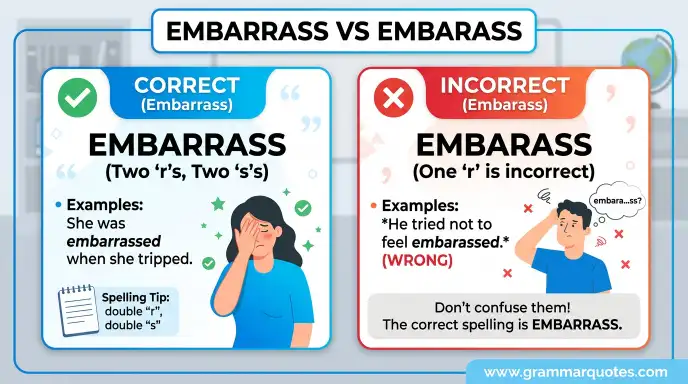
The correct spelling is embarrass, with two r letters and two s letters. Embarass is a common misspelling and should not be used in standard English writing. The word embarrass means to make someone feel uncomfortable, self conscious, awkward, or ashamed.
For example, you can say, “I did not want to embarrass my friend in front of the class.” You can also use it when talking about an awkward situation, a mistake, or something that makes a person feel uncomfortable.
In this guide, you will learn the correct spelling, meaning, pronunciation, word history, grammar rules, and everyday examples of embarrass. You will also discover common spelling mistakes, related words, and answers to frequently asked questions so you can use the word confidently in your writing.
Quick Answer: Embarrass vs Embarass
Embarrass is the correct spelling. Embarass is incorrect in standard English.
| Feature | Embarrass | Embarass |
| Spelling status | Correct | Incorrect |
| Meaning | To make someone feel awkward or ashamed | No separate standard meaning |
| Double letters | Double r and double s | One r and double s |
| Pronunciation | /ɪmˈbærəs/ | Intended to represent the same word |
| Example | Please do not embarrass me. | Incorrect spelling |
| Usage | Standard English | Common spelling mistake |
Easy rule to remember: The word embarrass has double R and double S.
Correct: “I did not mean to embarrass you.”
Incorrect: “I did not mean to embarass you.”
Embarrass: Definition and Meaning
Embarrass is a verb that means to make someone feel uncomfortable, awkward, self conscious, or ashamed, especially in front of other people.
It can describe an action, an unexpected situation, or an experience that makes someone feel uneasy.
Examples of Embarrass in Sentences
- I did not want to embarrass my friend.
- Please do not embarrass me in front of my classmates.
- His mistake may embarrass him during the presentation.
- She tried not to embarrass her younger brother.
- The unexpected question seemed to embarrass the speaker.
In each example, embarrass describes making someone feel awkward or uncomfortable.
What Does Embarrass Mean in Everyday English?
In everyday English, embarrass is commonly used when someone feels awkward because of a mistake, an unexpected comment, or an uncomfortable situation.
For example:
- “You embarrassed me in front of everyone.”
- “I do not want to embarrass her.”
- “That question might embarrass him.”
The word can describe a mild awkward feeling or a more serious sense of shame, depending on the situation.
Embarass: Definition and Meaning
Embarass is a misspelling of embarrass. It is not the standard spelling used in modern English dictionaries.
People often write embarass because they forget that the correct word contains two r letters. This mistake is common because English spelling does not always make the number of repeated letters easy to remember.
Incorrect Examples of Embarass
- Incorrect: I do not want to embarass you.
- Correct: I do not want to embarrass you.
- Incorrect: She did not mean to embarass her friend.
- Correct: She did not mean to embarrass her friend.
- Incorrect: Do not embarass him in public.
- Correct: Do not embarrass him in public.
Why Do People Misspell Embarrass?
There are several reasons why people write embarass:
- They forget the second r.
- They remember the sound but not the exact spelling.
- They type quickly and do not proofread.
- They confuse it with other words that contain fewer repeated letters.
The simplest solution is to memorize the spelling pattern: EM BAR RASS.
The Main Differences Between Embarrass and Embarass
The main difference is spelling, not meaning.
1. Correct vs Incorrect Spelling
Embarrass is correct, while embarass is a misspelling.
- Correct: His comment could embarrass her.
- Incorrect: His comment could embarass her.
2. Double R and Double S
The correct spelling contains both repeated letters:
- Embarrass
Remember that there are two r letters and two s letters.
3. Meaning and Pronunciation
The misspelled form embarass does not have a separate standard English meaning. Writers who use it generally intend to write embarrass.
The standard pronunciation of embarrass is /ɪmˈbærəs/ in both American and British English, although accents can vary.
4. Use in Formal and Informal Writing
Always use embarrass in schoolwork, essays, emails, reports, social media posts, and professional writing.
Even in casual messages, the correct spelling makes your writing clearer.
Embarrass vs Embarass: British and American English
Both British and American English use the spelling embarrass. There is no standard regional spelling difference between these varieties.
| Feature | British English | American English |
| Correct spelling | Embarrass | Embarrass |
| Incorrect spelling | Embarass | Embarass |
| Pronunciation | /ɪmˈbærəs/ | /ɪmˈbærəs/ |
| Verb form | Embarrass | Embarrass |
| Past tense | Embarrassed | Embarrassed |
| Noun form | Embarrassment | Embarrassment |
Unlike words such as colour and color, this word does not have separate standard British and American spellings.
Which Spelling Should You Use: Embarrass or Embarass?
You should always use embarrass when you want to express the meaning of making someone feel awkward or ashamed.
Use Embarrass in Everyday Sentences
- I do not want to embarrass my parents.
- His question might embarrass the teacher.
- She did not intend to embarrass her friend.
- Please do not embarrass anyone during the meeting.
Avoid Embarass
Do not use embarass in standard English writing.
For example:
- Incorrect: I was afraid I might embarass myself.
- Correct: I was afraid I might embarrass myself.
- Incorrect: Do not embarass your classmates.
- Correct: Do not embarrass your classmates.
Remember the Correct Spelling
A simple memory trick is to remember that embarrass has two pairs of repeated letters: RR and SS.
You can also practise writing the word three times:
- Embarrass
- Embarrass
- Embarrass
Repeated practice can help you remember the spelling.
Common Mistakes When Using Embarrass
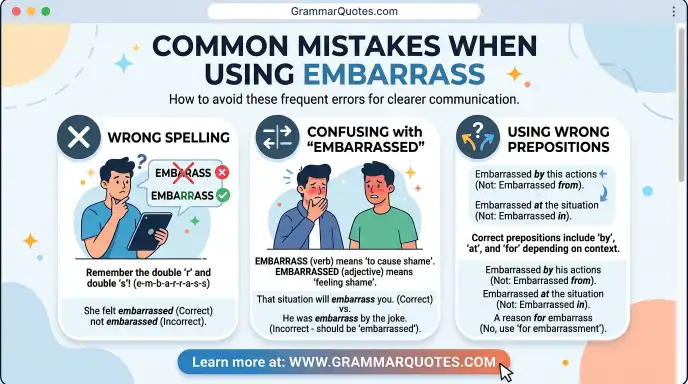
Mistake 1: Forgetting the Second R
Incorrect: I do not want to embarass anyone.
Correct: I do not want to embarrass anyone.
Why? The standard spelling contains two consecutive r letters.
Mistake 2: Using One S Instead of Two
Incorrect: I did not mean to embaras you.
Correct: I did not mean to embarrass you.
Why? The word ends with two consecutive s letters.
Mistake 3: Confusing Embarrass with Embarrassed
Embarrass is the base verb, while embarrassed is its past tense and past participle form. It can also describe how someone feels.
- Correct: I do not want to embarrass him.
- Correct: I embarrassed him yesterday.
- Correct: He felt embarrassed after the mistake.
Mistake 4: Confusing Embarrass with Embarrassment
Embarrass is a verb, while embarrassment is a noun.
- Correct: Do not embarrass your friend.
- Correct: His embarrassment was understandable.
Mistake 5: Assuming Embarass Is a British Variant
Incorrect assumption: Embarass is British English, while embarrass is American English.
Correct understanding: Embarrass is the standard spelling in both British and American English.
Embarrass: Everyday Examples
Here are 20 examples that show how to use the correct spelling naturally.
- I did not mean to embarrass you.
- Please do not embarrass your brother.
- She was afraid of making a mistake that might embarrass her.
- His joke could embarrass someone.
- I never want to embarrass my parents.
- The question seemed to embarrass the student.
- He did not intend to embarrass his friend.
- Try not to embarrass anyone during the discussion.
- The unexpected announcement may embarrass her.
- I felt nervous that I might embarrass myself.
- She apologized because she did not want to embarrass him.
- The teacher corrected the mistake without trying to embarrass the student.
- His careless comment could embarrass the whole team.
- They tried not to embarrass their guests.
- I would never intentionally embarrass you.
- The speaker’s mistake did not embarrass him for long.
- She asked the question privately so she would not embarrass her colleague.
- He worried that his answer might embarrass him.
- A respectful person avoids trying to embarrass others.
- Everyone makes mistakes, so there is no need to embarrass someone over a small error.
Embarass vs Embarrass: Quick Comparison Table
| Sentence | Correct Form | Explanation |
| I do not want to ___ you. | Embarrass | Correct spelling |
| She did not mean to ___ him. | Embarrass | Double R and double S |
| He felt ___ after the mistake. | Embarrassed | Past participle describing a feeling |
| His ___ was obvious. | Embarrassment | Noun form |
| Please do not ___ your friend. | Embarrass | Base verb |
| The comment could ___ her. | Embarrass | Correct spelling in both dialects |
| I was afraid I might ___ myself. | Embarrass | Correct spelling |
| He tried not to ___ anyone. | Embarrass | Standard English form |
Word Origin and History of Embarrass
The English word embarrass entered English through French. It is associated with the French verb embarrasser, which historically carried meanings related to hindering, obstructing, or placing someone in difficulty.
Over time, the English word developed its familiar meaning of making someone feel awkward, uncomfortable, or ashamed.
The spelling became established with double r and double s. The incorrect spelling embarass usually results from forgetting one of the repeated letters.
Today, embarrass is a standard verb in both British and American English.
Word Formation and Grammar
Embarrass belongs to a word family that includes several related forms.
| Word Form | Part of Speech | Meaning | Example |
| Embarrass | Verb | To make someone feel awkward | Do not embarrass her. |
| Embarrasses | Verb | Present tense with a singular subject | His behavior embarrasses him. |
| Embarrassed | Past tense / adjective | Made to feel awkward | She felt embarrassed. |
| Embarrassing | Adjective / participle | Causing awkwardness | It was an embarrassing moment. |
| Embarrassment | Noun | The feeling or situation of being embarrassed | He hid his embarrassment. |
Examples of Related Forms
- Embarrass: I did not want to embarrass him.
- Embarrassed: He was embarrassed by his mistake.
- Embarrassing: Forgetting her name was embarrassing.
- Embarrassment: She laughed to hide her embarrassment.
Notice that the double r remains in each of these related forms.
Synonyms and Antonyms of Embarrass

Understanding synonyms and antonyms can help you expand your vocabulary.
Synonyms of Embarrass
These words can express similar ideas, depending on the context:
- Humiliate
- Fluster
- Disconcert
- Shame
- Awkwarden
- Mortify
- Unsettle
- Discomfit
Examples:
- His comment embarrassed her.
- His comment made her feel awkward.
- The unexpected question flustered him.
These words have different shades of meaning. For example, humiliate often suggests a more severe loss of dignity than embarrass.
Antonyms of Embarrass
Depending on the context, possible opposites include:
- Reassure
- Comfort
- Encourage
- Reassure
- Put at ease
Examples:
- Her teacher reassured her after the mistake.
- His kind words helped put her at ease.
- The host made the guests feel comfortable.
Embarrass vs Embarass: Key Takeaways
- Embarrass is the correct spelling.
- Embarass is a misspelling in standard English.
- The correct word has double R and double S.
- Both British and American English use embarrass.
- Embarrass is a verb meaning to make someone feel awkward or ashamed.
- Embarrassed describes a feeling or the result of an action.
- Embarrassing describes something that causes awkwardness.
- Embarrassment is the related noun.
- Remember the spelling pattern: EM BAR RASS.
- Always proofread repeated letters when writing words that are easy to misspell.
People Also Ask About Embarrass vs Embarass
1. Is It Embarrass or Embarass?
Embarrass is correct. Embarass is a common misspelling.
2. Why Does Embarrass Have Two Rs?
The spelling of embarrass developed through its history in English and French. In modern English, the standard spelling uses two consecutive r letters.
3. Does Embarrass Have Two S Letters?
Yes. The correct spelling is embarrass, with two r letters and two s letters.
4. Is Embarrass British or American English?
It is used in both British and American English. There is no standard regional spelling difference.
5. What Is the Past Tense of Embarrass?
The past tense is embarrassed.
Example: I embarrassed myself during the presentation.
6. What Is the Noun Form of Embarrass?
The noun form is embarrassment.
Example: He tried to hide his embarrassment.
Frequently Asked Questions (FAQs)
Is Embarass Ever Correct?
No. In standard modern English, embarass is a misspelling of embarrass.
How Do You Remember the Spelling of Embarrass?
Remember that embarrass has two pairs of repeated letters: RR and SS. Writing the word several times can also help you memorize it.
What Is the Difference Between Embarrass and Embarrassed?
Embarrass is the base verb, meaning to make someone feel awkward or ashamed. Embarrassed is the past tense form and can also describe a person’s feelings.
What Is the Difference Between Embarrass and Embarrassing?
Embarrass describes the action of making someone feel awkward. Embarrassing describes something that causes that feeling.
Example: The mistake embarrassed him, and it was an embarrassing moment.
Can Embarrass Be Used in Formal Writing?
Yes. Embarrass is a standard English word suitable for formal writing, academic assignments, emails, and everyday conversations.
Is Embarrass a Verb or a Noun?
Embarrass is a verb. Its related noun is embarrassment.
Conclusion
Understanding embarrass vs embarass is a simple but useful step toward improving your English spelling. Although both forms look similar, only embarrass is correct in standard English. The incorrect form embarass usually appears when writers forget one of the two r letters. The correct spelling contains double R and double S, and it is used in both British and American English.
The word embarrass means to make someone feel awkward, uncomfortable, self conscious, or ashamed. Its related forms include embarrassed, embarrassing, and embarrassment. Learning these forms can help you use the word correctly in different sentences.
To remember the spelling, practise writing EM BAR RASS and pay attention to both pairs of repeated letters. if you are writing a school assignment, an email, a social media caption, or a professional document, always choose embarrass instead of embarass. With regular practice, you can avoid this common spelling mistake and communicate more confidently in English.
Discover More Articles!
Color or Colour: Correct Spelling, Meaning, and Examples
Motorhome or RV: What Is the Difference?(2026)
Definitely or Definately: Correct Spelling, Meaning, and Examples

Ethan Parker is an English-language writer known for his interest in words, language, and clear communication. His work focuses on making everyday English easier to understand through simple explanations and practical examples.